

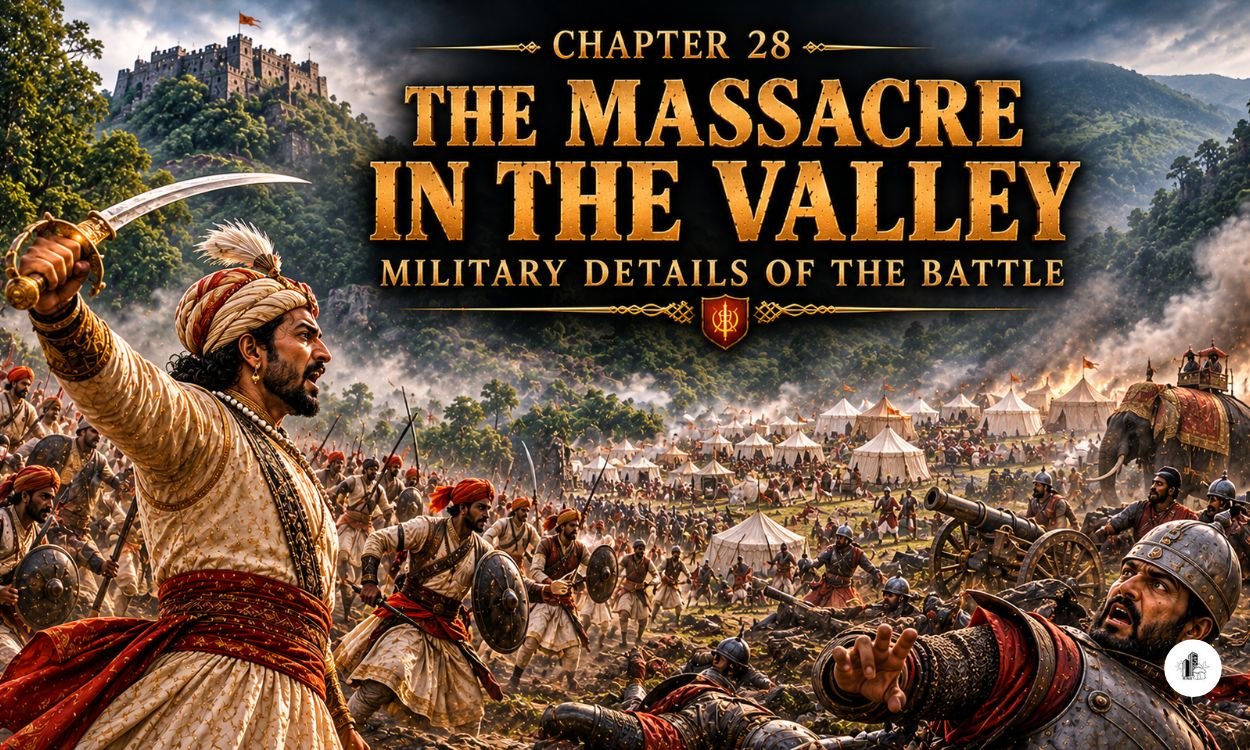
The Swarajya Chronicles: Book 3, Chapter 28
Current Focus: The Diplomatic Tightrope (1648–1659)
Progress: 28 / 100 Chapters Completed….
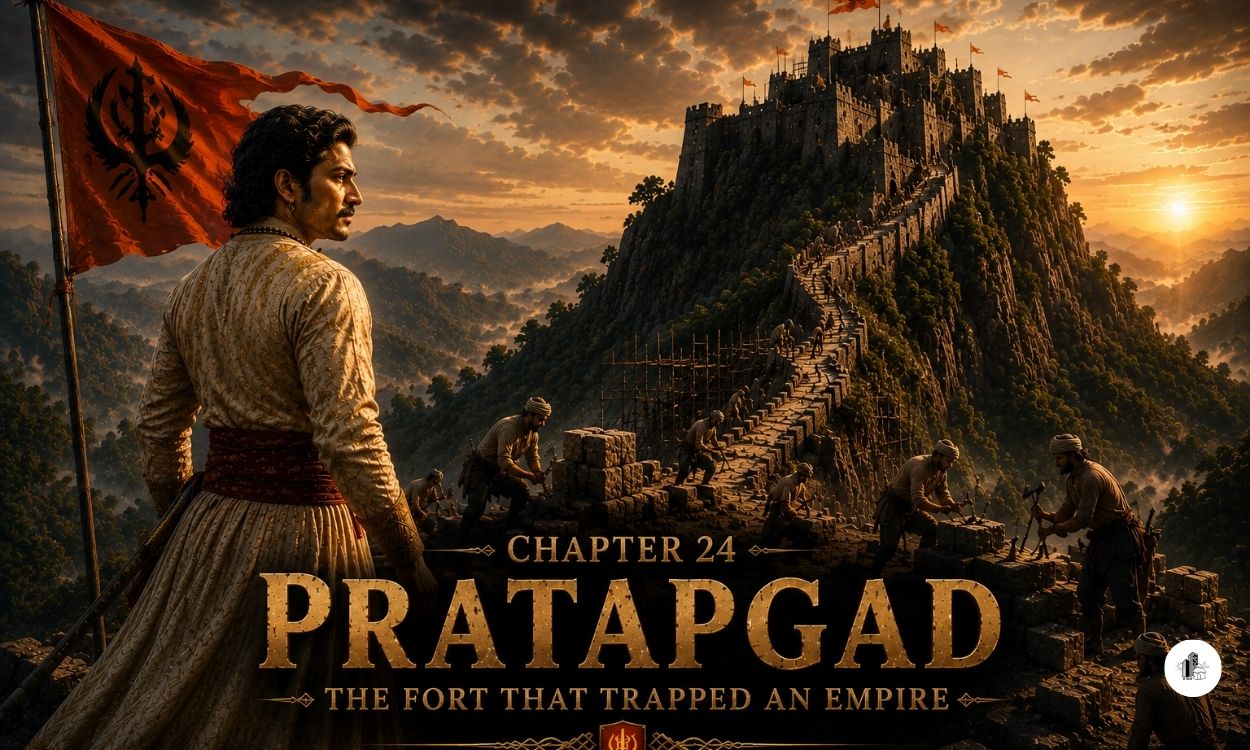
At 2:00 PM on November 10, 1659, a single brass cannon fired from the top of Pratapgad Fort. The heavy iron ball cut through the misty afternoon air. That single booming sound did not aim to hit an enemy soldier. It was a precise acoustic signal.
Within seconds, thousands of hidden Maratha fighters burst out of the dense bamboo groves of Jawali. Chhatrapati Shivaji Maharaj had just eliminated Afzal Khan inside the meeting tent. Now, his pre-planned military trap snapped shut on an army of 12,000 imperial troops trapped in the valley below.
Pratapgad Fort overlooking the Jawali valley. Source: Vinayak Jagtap / Getty Images
The Geography of a Kill-Zone
The Battle of Pratapgad was not a traditional medieval clash on flat grass. It was a calculated industrial-scale ambush designed around brutal geography.
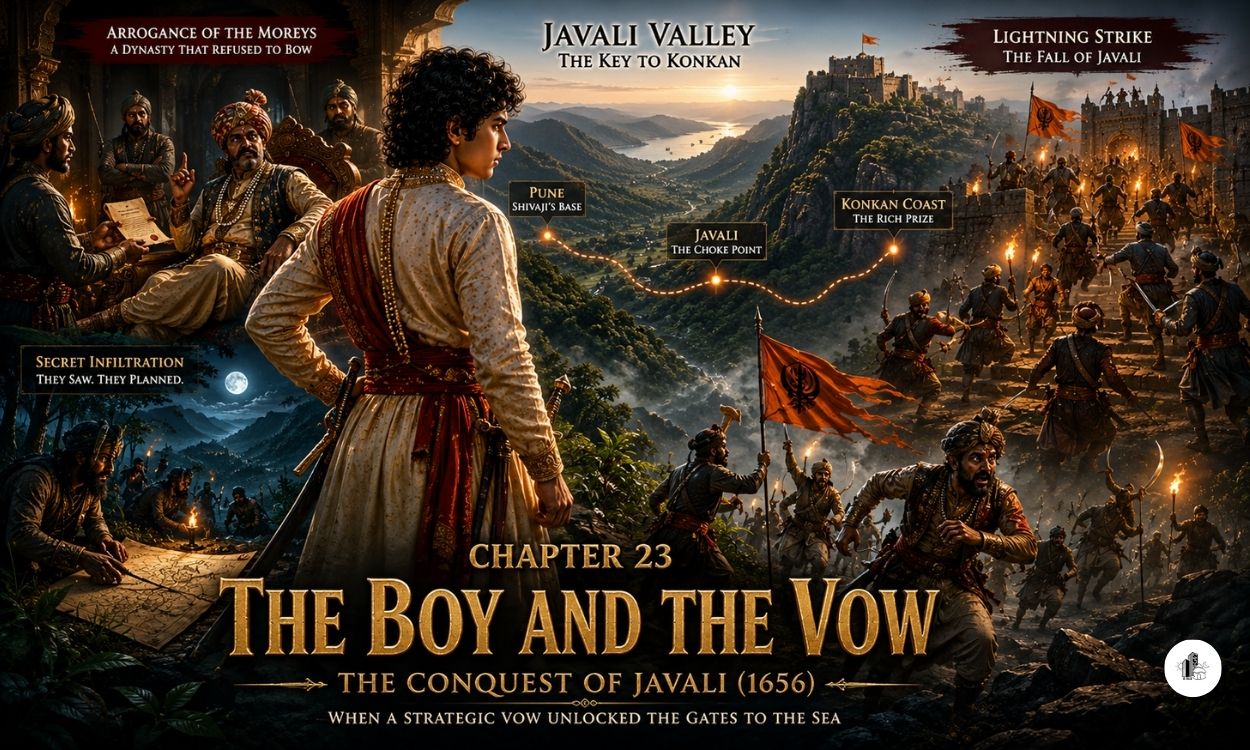
Afzal Khan’s army sat camped in the narrow, uneven basin around Par village. Thick subtropical forests surrounded them on every side. Steep basalt cliffs towered directly above their white canvas tents.
Primary historical records like the Jedhe Shakavali and the Sabhasad Bakhar explain why the Bijapur army failed to form battle lines. Their heavy war horses stood tied up in tight rows. Their massive bronze cannons sat stuck in the mud, pointed the wrong way. The imperial troops had completely lowered their guard, expecting their general to return with a captured rebel in chains.
“Wait, have you read this yet?”
The Three-Pronged Maratha Deployment
Chhatrapati Shivaji Maharaj did not leave his soldiers waiting in a single big crowd. He split his elite light infantry into specialized tactical divisions. Each unit held a specific geometric position in the hills before the meeting even started.
                  ┌──► Kanhoji Jedhe (Hits the Main Artillery Camp)
  Maratha Ambush  ├──► Moropant Pinglay (Blocks Northern Escape Passes)
   Command Grid   └──► Netaji Palkar (Sweeps Lower Plains & Rear Guard)
The Frontal Strike: Kanhoji Jedhe and his seasoned Maval clan warriors charged straight down the steep slopes into the main Bijapur camp. They targeted the artillery crews first to prevent them from firing a single shot.
The Choke-Point Lock: Moropant Pinglay moved his infantry divisions across the Radtondi Pass and the Par Ghat. He physically sealed the narrow mountain roads, trapping the fleeing enemy inside the valley.
The Cavalry Sweep: Netaji Palkar, the chief of the Maratha cavalry, waited quietly in the lower scrublands near Wai. His fast horsemen cut down any disorganized imperial units that managed to escape the forest trap.
Weapons, Armor, and Logistics in the Jungle
In dense forest combat, heavy equipment becomes a death sentence. The Bijapur soldiers wore thick iron breastplates and carried long, heavy cavalry lances. These weapons got tangled in the low tree branches and thick vines.
Meanwhile, the Maratha infantry fought with extreme speed and light gear. Their survival depended on simple regional logistics. For days, these men lived inside the cold, damp bushes on pocket rations of dry Bhakri flatbread, garlic chutney, and water.
17th-century close-combat swords, daggers, and armor. Source: Arjun Sunil / Getty Images
| Combat Factor | Bijapur Imperial Force | Maratha Ambush Force |
| Primary Armor | Heavy metal plates and thick padded coats | Light cotton tunics and basic leather shields |
| Main Weapons | Long lances and heavy matchlock muskets | Short curved swords (Firangi), spears, and bows |
| Movement Speed | Slow, blocked by tied horses and tents | High-speed barefoot climbing over wet rocks |
| Command Status | Leaderless, confused, and panicked | Coordinated via horn blasts and drum signals |
Contemporary Dutch and English factory records from Surat confirm the speed of this collapse. They noted that the proud Bijapur army turned into a terrified mob within the first hour of the horn blasts.
Loving this analysis? Let’s stay connected!
Join our WhatsApp & Telegram Channels: Get the latest movie alerts and box office updates directly on your phone. [WhatsApp] & [Telegram]
Follow us on X (Twitter): For quick threads, daily polls, and viral cinema news. [Click Here]
Join our Quora Space: Participate in deep discussions and share your own theories with fellow movie buffs. [Click Here]
The Collapse of the Imperial Command
Without Afzal Khan, the Bijapur chain of command broke down instantly. Senior officers tried to rally their troops, but they could not see their own men through the thick trees and gunpowder smoke.
Afzal Khan’s sons, Fazal Khan and Ghiyasuddin, realized the camp was lost. They abandoned their heavy baggage trains and personal treasures. Aided by a local traitor named Khandoji Khopde, Fazal Khan slipped through a hidden mountain path and fled toward Karad.
Other top generals, including Musa Khan and Ankush Khan, tried to fight back near the main tents. They died quickly under a hail of Maratha arrows and short-sword charges.
By 5:00 PM, the fighting inside the valley stopped. The dense green floor of Jawali was completely covered with abandoned weapons, shattered wagons, and fallen soldiers.
Post-Battle Administration and Law
Chaos usually follows a massive military massacre. Soldiers often break ranks to steal gold and burn camps. Chhatrapati Shivaji Maharaj prevented this breakdown through strict administrative discipline.
He immediately ordered his clerks to record every captured item. Nothing belonged to an individual soldier; everything belonged to the state treasury of Swarajya.
He also applied strict legal rules to the surrounding villages. Using local administrative records known as Mahazars, his officers verified the exact crop damage suffered by local farmers during the invasion. The state paid cash compensation to innocent civilians whose fields were trampled by the imperial horses.
Furthermore, Chhatrapati Shivaji Maharaj enforced his strict ethical code regarding prisoners. Surrendered soldiers were disarmed, fed, and released safely. Captured women and children were escorted back to Bijapur territory under armed Maratha protection.
The Geopolitical Shockwave
The Battle of Pratapgad permanently changed the military balance of India. Before November 10, 1659, the major empires viewed the Marathas as a minor nuisance hiding in the hills.
In a single afternoon, a small regional force completely destroyed an elite imperial army without fighting a single traditional open-field battle. Chhatrapati Shivaji Maharaj proved that superior terrain knowledge, strict logistics, and coordinated ambush tactics could defeat massive numbers and heavy artillery. The door to the rich plains of Maharashtra and the western coastline now stood wide open.
What Do You Think?
Did Afzal Khan’s arrogance in entering the Jawali valley cause his defeat, or did Chhatrapati Shivaji Maharaj defeat him with his brilliant multi-layered ambush? How important is discipline after a battle when managing captured wealth and prisoners?







Leave a Reply