

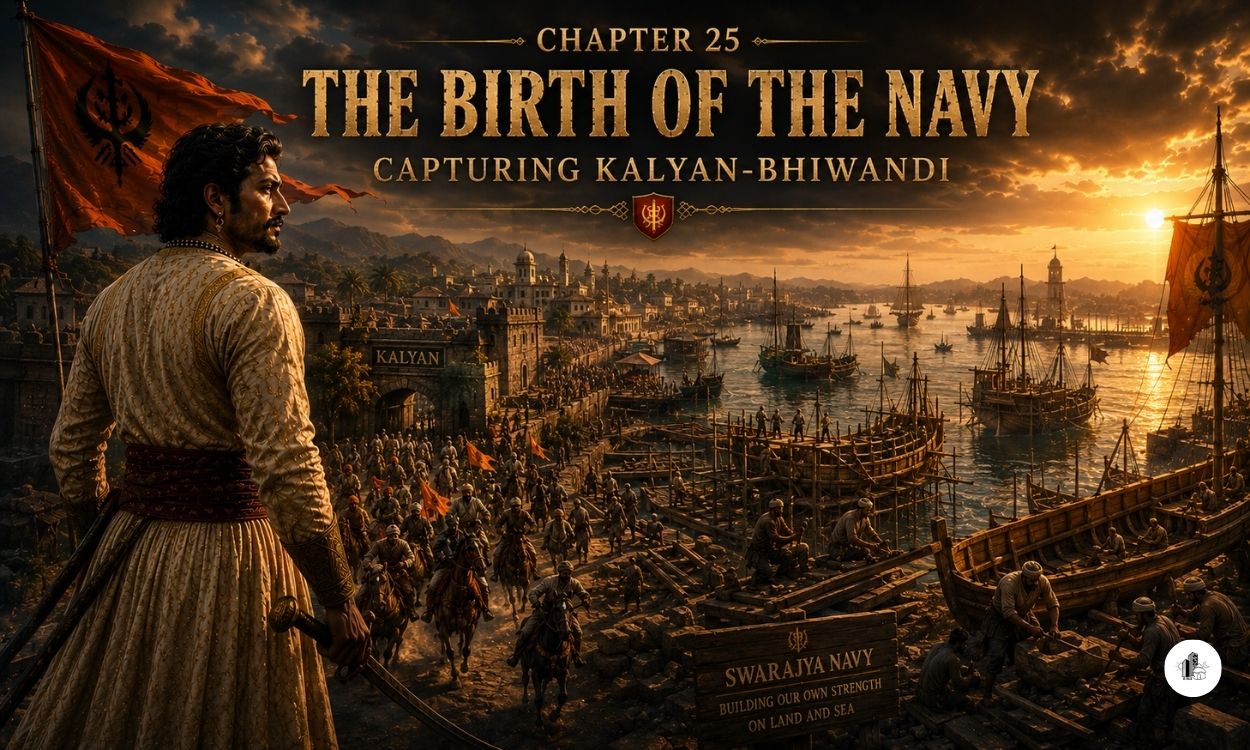
The Swarajya Chronicles: Book 3, Chapter 25
Current Focus: The Boy and the Vow (1648–1659)
Progress: 25 / 100 Chapters Completed….
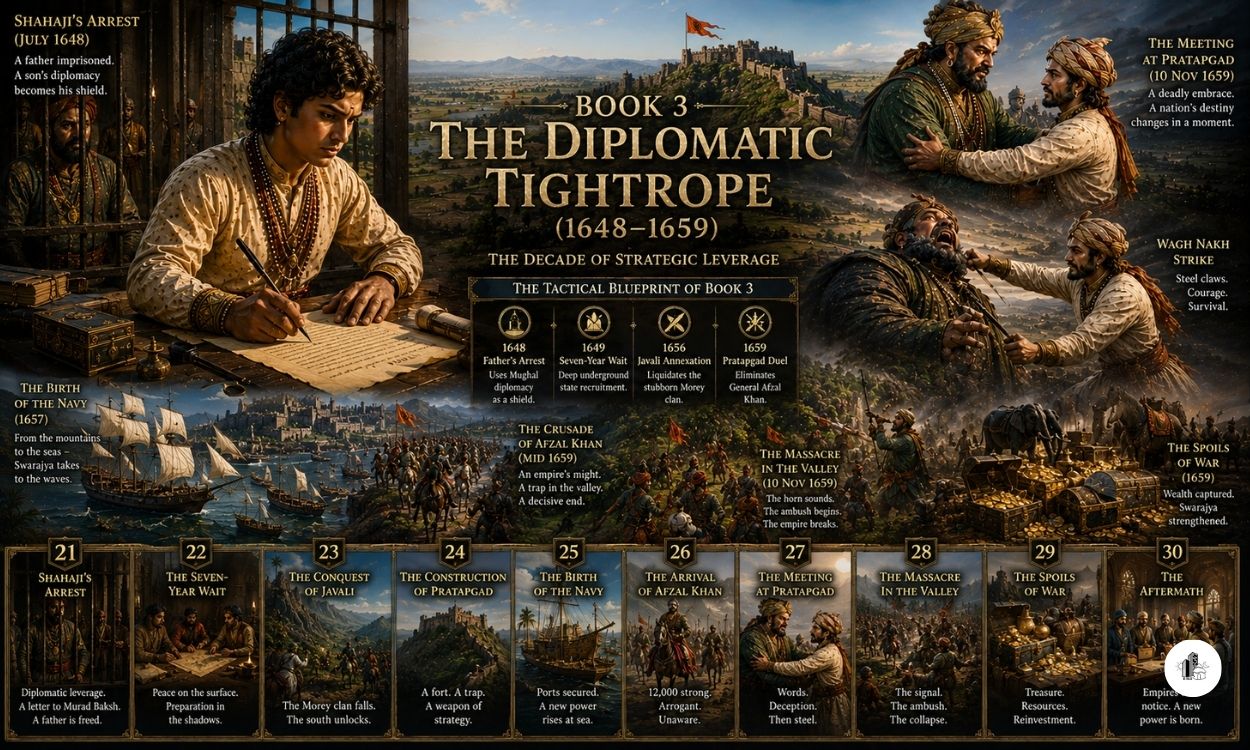
On October 24, 1657, Maratha cavalry cut down the imperial guards at the gates of Kalyan. They moved with extreme speed. Within a few hours, Chhatrapati Shivaji Maharaj’s forces captured the entire twin administrative ports of Kalyan and Bhiwandi.
The Adilshahi Sultanate lost a massive source of tax revenue that morning. More importantly, they lost their direct connection to the Arabian Sea.
Before this raid, Chhatrapati Shivaji Maharaj was purely a king of the mountains. His power stopped where the flat coastal plains began. By capturing these specific towns, he gained something far more valuable than gold. He acquired fully functional, saltwater shipyards and deep-river channels. He used these captured assets to build the first native Indian blue-water navy of the era.
The Strategic Value of the Saltwater Gateways
Kalyan and Bhiwandi were not simple farming villages. They were highly lucrative international trading centers. The two towns sat perfectly on navigable creeks. They linked the deep inland markets of the Deccan plateau to global maritime shipping routes.
Primary records like the Jedhe Shakavali show that this attack shocked the entire region. The local governor, Mulla Ahmad, was traveling away from the city during the raid. The defense system collapsed instantly without its top commander.
Chhatrapati Shivaji Maharaj did not just loot the warehouses and leave. He occupied the territory permanently. He realized that the land-locked dream of Swarajya could never survive if foreign empires controlled the open oceans.
The geography of the Konkan coast acted as a giant natural funnel. Wealth from the inner Deccan passed down through dangerous mountain passes. It ended up directly at these river ports.
By holding this point, the Maratha state choked the financial pipeline of Bijapur. They simultaneously opened a direct doorway to global diplomacy and maritime wealth.
“Wait, have you read this yet?”
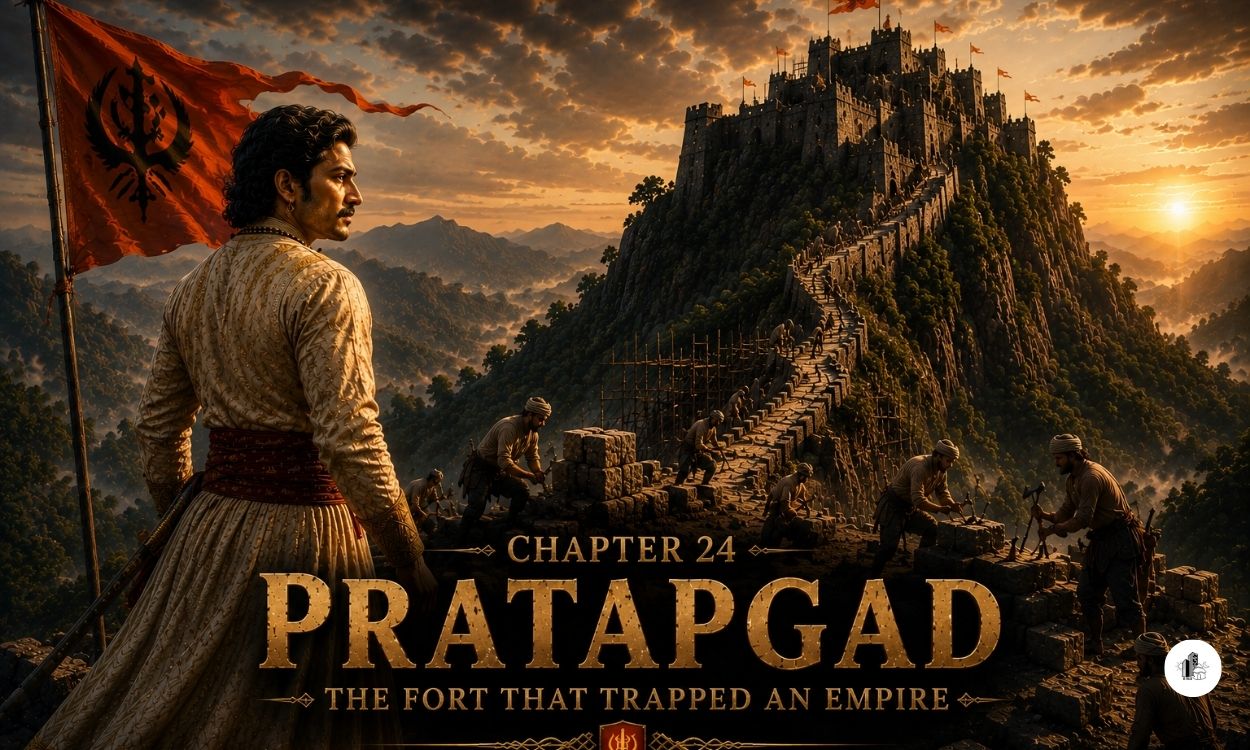
Chapter 24: The Construction of Pratapgad Fort to Trap an Ego
The Wooden Walls: Building the Shipyards
Immediately after securing the riverbanks, Chhatrapati Shivaji Maharaj brought in structural engineering experts. He appointed Maynak Bhandari and Daryasarang Gunvantrao to lead his new maritime department.
They did not invent new ship designs from scratch. Instead, they hired the local traditional fishermen and shipbuilders of the Konkan coast. These communities knew the dangerous tides of the Arabian Sea perfectly.
-
-
The Local Talents: The Kolis, Bhandaris, and local Portuguese technicians joined the payroll.
-
The Raw Materials: Teak wood from the dense Sahyadri forests was floated down the Ulhas River.
-
The First Fleet: The shipyards began building twenty medium-sized warships, including Gurabs and Galbats.
-
The Gurab was a heavy, shallow-draft vessel ideal for coastal defense. It carried heavy guns to match European fire. The Galbat was a lighter, faster boat built for quick tactical maneuvers and boarding operations.
Together, these vessels formed a lethal combination. They allowed the nascent navy to fight inside narrow creeks and shallow waters where larger European galleons would easily run aground.
Contemporary European factory records from the British East India Company at Surat note this sudden building project. The English merchants expressed deep anxiety about a mountain king suddenly building warships. They saw their unchallenged control over the sea beginning to slip away.
The Psychological Shift: Breaking the Saltwater Curse
For centuries, local rulers across India suffered from a deep psychological barrier regarding ocean travel. Many communities believed that crossing the open sea caused spiritual pollution. This taboo was known as Kala Pani.
Foreign powers like the Portuguese, the Dutch, and the Siddis of Janjira used this superstition to their absolute advantage. They controlled the waves and forced local merchants to pay massive protection fees.
Chhatrapati Shivaji Maharaj broke this systemic vulnerability with a single administrative decree. He declared that the sea belonged to the people of the land. He ignored old religious taboos completely.
Chhatrapati Shivaji Maharaj offered steady government salaries to any local sailor who joined his fleet. The common sailors prepared their portable rations of dry Bhakri flatbread and salted fish. They boarded their new wooden ships to challenge global superpowers.
This was a major shift in psychological warfare. For generations, local populations viewed the ocean as a hostile, forbidden void.
The Maratha state turned it into a highway of native power. They transformed humble fishermen into disciplined naval soldiers who no longer feared the foreign vessels patrolling the horizon.
Loving this analysis? Let’s stay connected!
Join our WhatsApp & Telegram Channels: Get the latest movie alerts and box office updates directly on your phone. [WhatsApp] & [Telegram]
Follow us on X (Twitter): For quick threads, daily polls, and viral cinema news. [Click Here]
Join our Quora Space: Participate in deep discussions and share your own theories with fellow movie buffs. [Click Here]
Demographics and the Legal Framework of the Coast
Managing a newly conquered coastal zone required careful domestic administration. The population of Kalyan-Bhiwandi was highly diverse. It included Hindu fishermen, Muslim merchants, and European traders.
Chhatrapati Shivaji Maharaj utilized traditional legal settlement documents, called Mahazars, to protect the properties of the local merchant class. He did not discriminate based on religious background.
He kept the existing maritime trade laws active. This smart continuity ensured that international business did not freeze out of panic. The transition was smooth, profitable, and highly organized.
| Metric of Power | Maratha State Before Kalyan (1656) | Maratha State After Kalyan (1657) |
| Territorial Limit | Landlocked inside the Sahyadri mountains | Direct access to the Arabian Sea coastline |
| Economic Base | Local agricultural taxes from valleys | International maritime trade customs duties |
| Military Reach | High-speed mountain infantry and cavalry | Dual-threat amphibious land and sea forces |
| Primary Logistics | Mountain fort storages | Deep-river shipyards and naval supply depots |
The use of Mahazars showed that Swarajya was built on a foundation of strict law, not arbitrary military rule. By respecting local trade customs, the Marathas avoided costly coastal rebellions. Local merchant families quickly chose to support the new government over distant sultans.
The Blueprint for Sea Power
The conquest of Kalyan and Bhiwandi was the true birth of the Maratha Navy. Chhatrapati Shivaji Maharaj proved that he could adapt his strategies to any geographical environment.
Chhatrapati Shivaji Maharaj did not build a navy just to parade his flags on the water. He built it to construct island fortresses, protect domestic merchants, and deny foreign empires a monopoly on Indian waters. The mountain king had successfully evolved into a coastal sovereign. The chessboard of the Deccan was now permanently linked to the global oceans.
The shipyards of Kalyan-Bhiwandi provided the essential template for future naval fortification projects. Lessons learned here directly influenced the construction of impenetrable island fortresses like Sindhudurg and Vijaydurg. These sea citadels would defend the coastline against foreign armadas for well over a century.
What Do You Think?
Do you think capturing pre-existing shipyards was a better strategy than trying to build a fleet from scratch in a remote area? How would world history change if Indian kingdoms had built powerful navies centuries before the Europeans arrived?









Leave a Reply