

The Swarajya Chronicles: Book 2, Chapter 14
Current Focus: The Boy and the Vow (1630–1647)
Progress: 15 / 100 Chapters Completed….
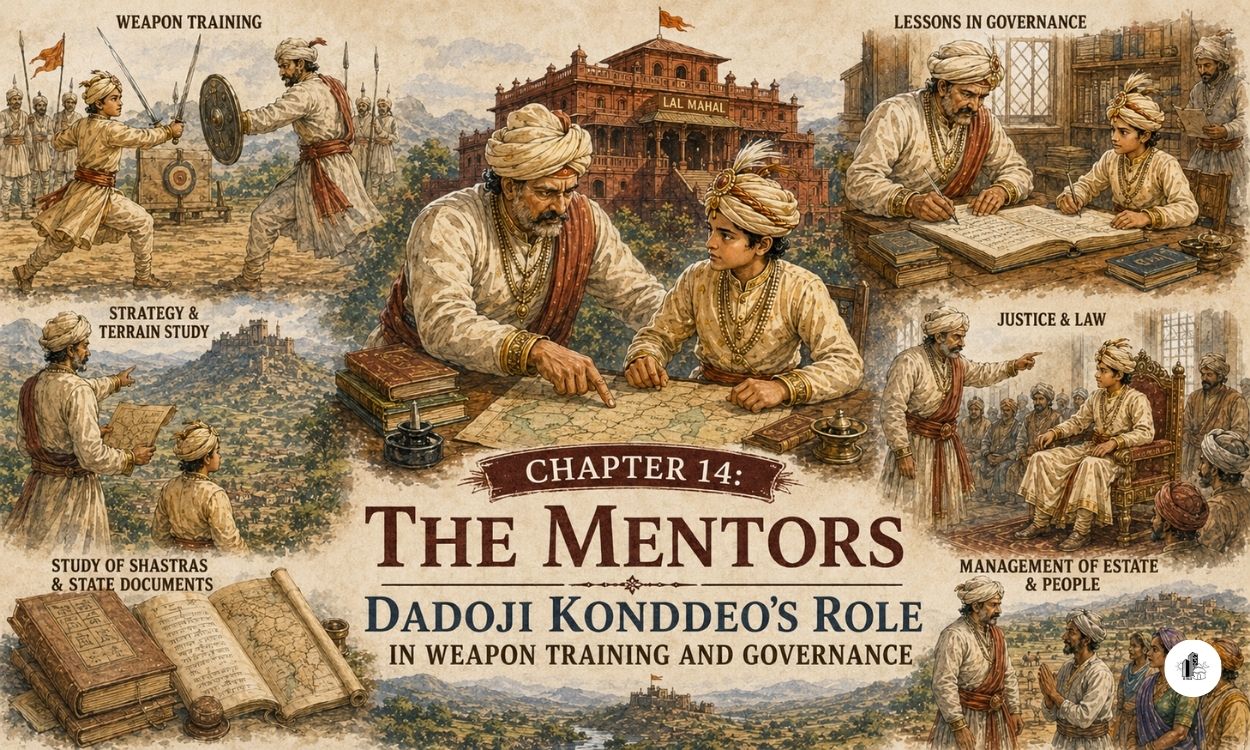
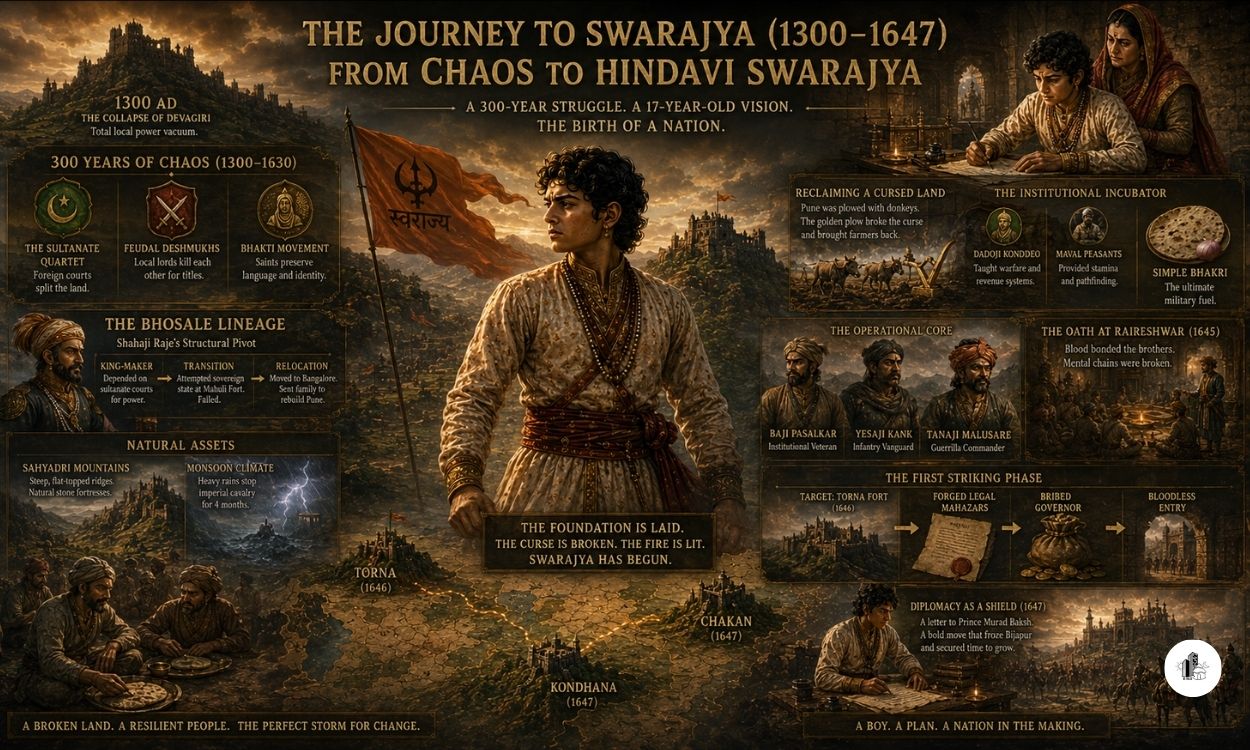
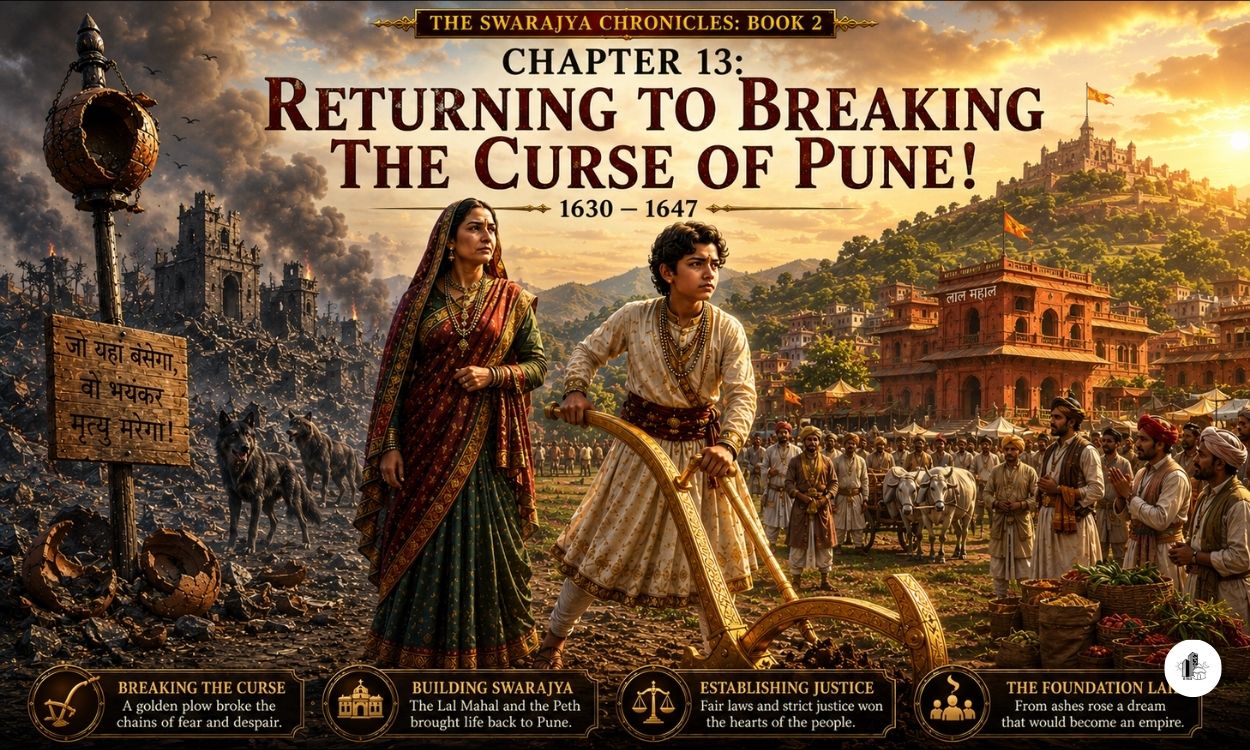
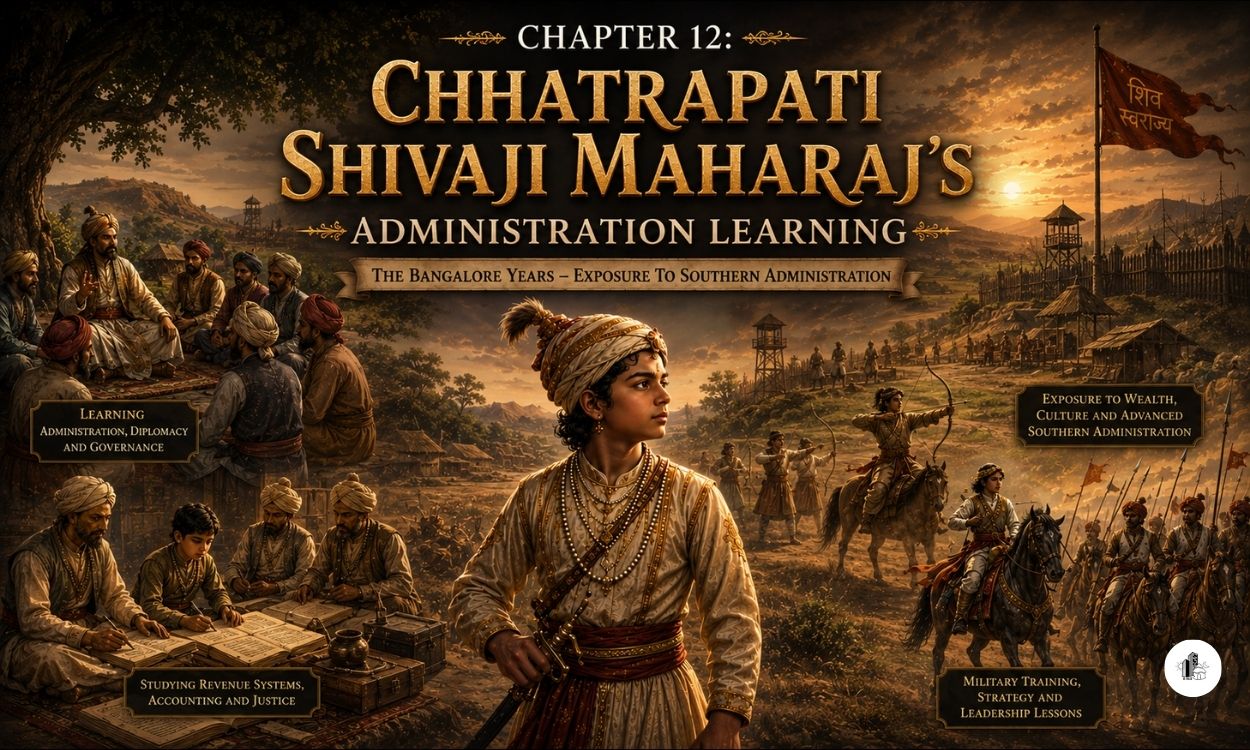
By 1640, the Pune jagir was a political landmine. Local warlords ran private extortion rackets, the Bijapur Sultanate watched every tax coin with deep suspicion, and a young Shivaji Maharaj was handed the keys to a ruined estate. This was no royal playground; it was a brutal trial by fire. The burning ideals of Hindavi Swarajya passed down by Maa Jijau provided the vision, but an empire cannot be built on raw emotion alone. The young prince needed to master the exact mechanics of Deccani law, the cold physics of martial combat, and the grueling logistics of border administration.
To turn this raw potential into a systematic threat to the ruling empires, Shahaji Raje selected Dadoji Konddeo. He was a veteran administrator, a master diplomat, and an unyielding bureaucrat who understood how to command absolute obedience in a chaotic frontier.
The Master of the Jagir: Who Was Dadoji Konddeo?
Historical accounts, including the contemporary Sabhasad Bakhar, reveal that Dadoji Konddeo was far more than a simple childhood tutor. He was the official Subhedar (governor) of the Pune region under the Adilshahi framework. Dadoji Konddeo walked into a valley broken by decades of scorched-earth warfare and immediately established an iron-clad judicial order. He wore the simple attire of a Deccani clerk, kept immaculate accounting records, and delivered swift, blind justice that terrified corrupt local elites.
Before his arrival, powerful local landlords (Deshmukhs) routinely abused the peasantry, stealing crops and ignoring central authority. Dadoji Konddeo crushed this lawlessness. He instituted a rigid code of personal discipline and zero financial corruption. For a young Shivaji Maharaj, this man was the living definition of state authority. He showed the prince that a ruler must first bring order to his own household before he can dream of conquering foreign empires.
“Wait, have you read this yet?”
The Martial Academy: Weapon Training in the Hills
A 17th-century Deccani king could not lead his men from a distant, safe bunker. He had to be the most proficient and lethal combatant on the battlefield. Under Dadoji Konddeo’s watchful eye, the inner courtyards of the newly built Lal Mahal became a strict, high-intensity military training academy.
The daily routine began long before the winter mists cleared from the Pune hills. Chhatrapati Shivaji Maharaj spent hours mastering the foundational footwork of traditional Maratha martial arts, known today as Mardani Khel. He learned how to swing the heavy, straight-bladed Dhop sword without losing his balance on treacherous, uneven mountain slopes.
According to regional military traditions, the training quickly advanced to complex weapons: the deadly Patta (the flexible gauntlet sword) and the Danpatta.
Dadoji Konddeo brought in elite veterans from the surrounding hills to teach young Shivaji Maharaj how to fire a matchlock musket with absolute precision under high-stress conditions. He forced the young prince to spend days in the saddle, learning to command a warhorse through steep ravines and dense, thorny jungles. This was not a sports club for a young noble; it was survival training for a massive geopolitical shift that would soon demand oceans of blood.
Beyond the Sword: Lessons in Asymmetric Strategy
Military brilliance relies heavily on understanding your limitations. Dadoji Konddeo looked at the massive, cash-rich standing armies of the Mughal Empire and the Adilshahi Sultanate and realized a crucial fact: the Marathas would face total annihilation in a conventional, open-field battle.

He systematically taught the young prince to view the Sahyadri mountains not as obstacles, but as active, powerful military allies. They spent weeks analyzing the architecture of local hill forts, mapping out their structural blind spots, water pathways, and hidden escape routes. The tutor showed him how a tiny group of disciplined men, positioned correctly in a narrow mountain pass (Ghat), could easily decimate an invading army ten times its size. Chhatrapati Shivaji Maharaj learned to read old terrain maps, track weather patterns, and use the pitch-black cover of the Deccan monsoons as a tactical shield. The prince was being trained to wage a highly organized campaign of asymmetric warfare.
Loving this analysis? Let’s stay connected!
Join our WhatsApp & Telegram Channels: Get the latest movie alerts and box office updates directly on your phone. [WhatsApp] & [Telegram]
Follow us on X (Twitter): For quick threads, daily polls, and viral cinema news. [Click Here]
Join our Quora Space: Participate in deep discussions and share your own theories with fellow movie buffs. [Click Here]
The Blueprint of Governance and Law
An army can conquer a fort in a single night, but only an honest administration can hold a territory for generations. Dadoji Konddeo’s most enduring gift to the young prince was a masterclass in clean, unyielding legal bureaucracy.
He dragged young Shivaji Maharaj away from the training grounds. He forced him to sit through real local judicial assemblies, known as Mahazars. Together, they walked through small farming villages. They personally audited land revenue records. They settled violent, multi-generational boundary disputes between rival clans.
The old administrator taught the boy a radical lesson. A king’s true power comes from protecting the lowest peasant. It does not come from pleasing the richest noble. He built a transparent governance system. A poor farmer could walk straight to the administration gates and demand an honest hearing. This deep focus on absolute fairness reshaped the young prince’s mind. It created the ethical backbone of the Swarajya blueprint.
Technical Analysis: The Pedagogical Infrastructure
The rigorous educational framework designed by Dadoji Konddeo rested on four distinct tactical pillars that converted a young rebel into an empire builder:
| Tactical Pillar | Practical Execution | Strategic Result |
| Holistic Martial Mastery | Combining traditional Mardani Khel with active terrain combat drills. | Created a leader who was lethal in close-quarters mountain fighting. |
| Administrative Literacy | Forcing the prince to personally review revenue audits and sign Mahazars. | Turned a teenage revolutionary into a highly competent legal administrator. |
| Asymmetric Mobilization | Training local valley youth instead of hiring expensive foreign mercenaries. | Formed the low-cost, fiercely loyal backbone of the early Maratha infantry. |
| Ethical Guardrails | Enforcing strict personal frugality and absolute respect for public funds. | Built a governance model that won the unconditional trust of the populace. |
The Graduation of a Rebel
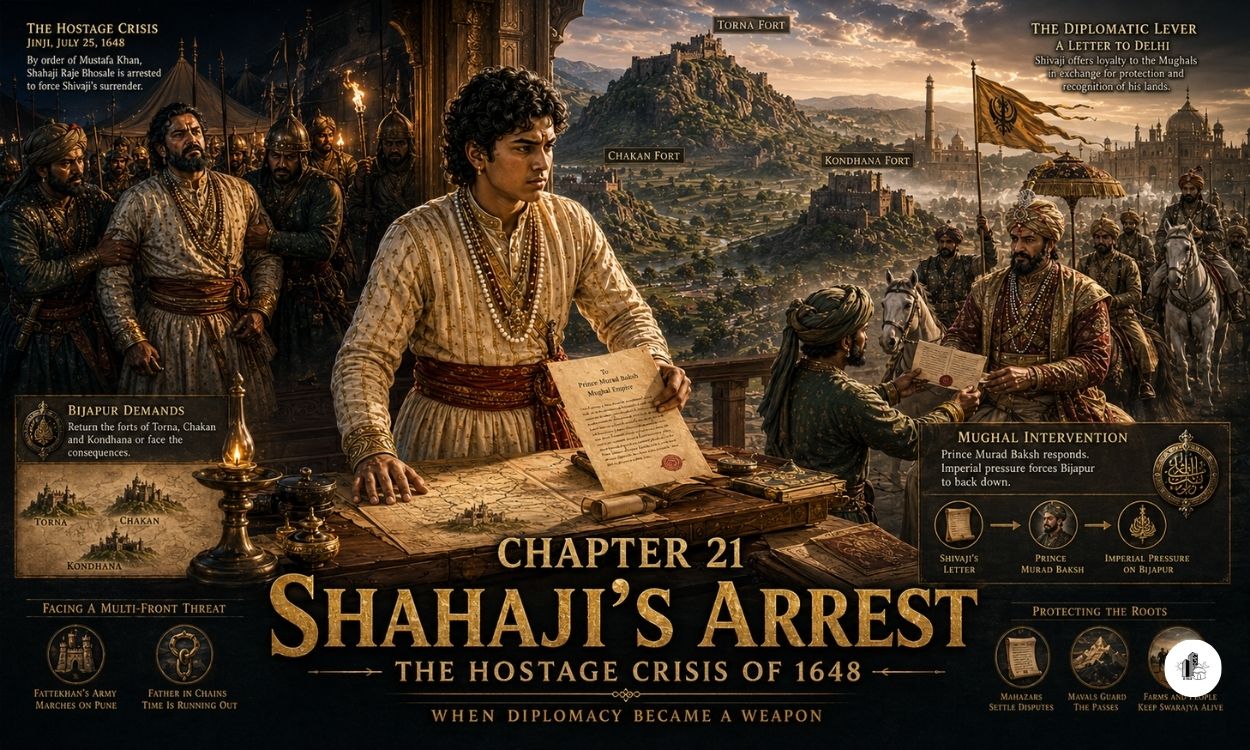
By 1645, a sharp friction began to develop between the aging mentor and the young prince. Dadoji Konddeo was a loyalist of the existing system; he wanted to build a stable, wealthy estate within the legitimate boundaries of the Bijapur Sultanate. But Chhatrapati Shivaji Maharaj refused to be a well-behaved servant to a foreign king. He wanted complete, uncompromised freedom for his people.
Contemporary records suggest the old mentor often grew terrified of the young prince’s highly dangerous, underground operations. Yet, the iron-clad training he had provided was exactly what made those dangerous plans possible. He had given the boy the precise administrative and military tools needed to shatter the very system he served. The hands were trained, the legal mind was sharp, and the mountain tracks were mapped. The boy was now fully armed, highly dangerous, and ready to strike.
What Do You Think?
Do you believe that strict, rigid discipline from an older mentor is absolutely necessary to create a truly great leader, or can raw passion alone change history? If you were Dadoji Konddeo, would you have tried to stop the young prince from rebelling to protect him, or would you have quietly cheered him on?








Leave a Reply