

The Swarajya Chronicles: Book 3, Chapter 27
Current Focus: The Boy and the Vow (1648–1659)
Progress: 27 / 100 Chapters Completed….
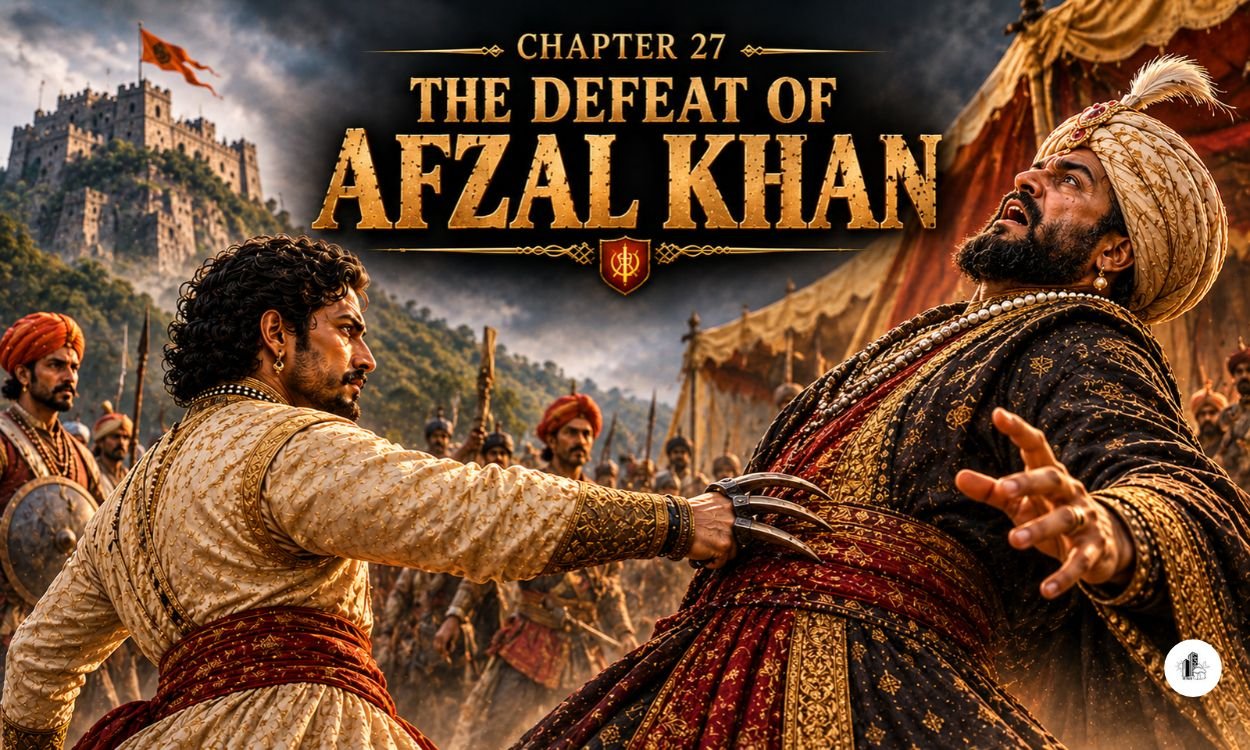
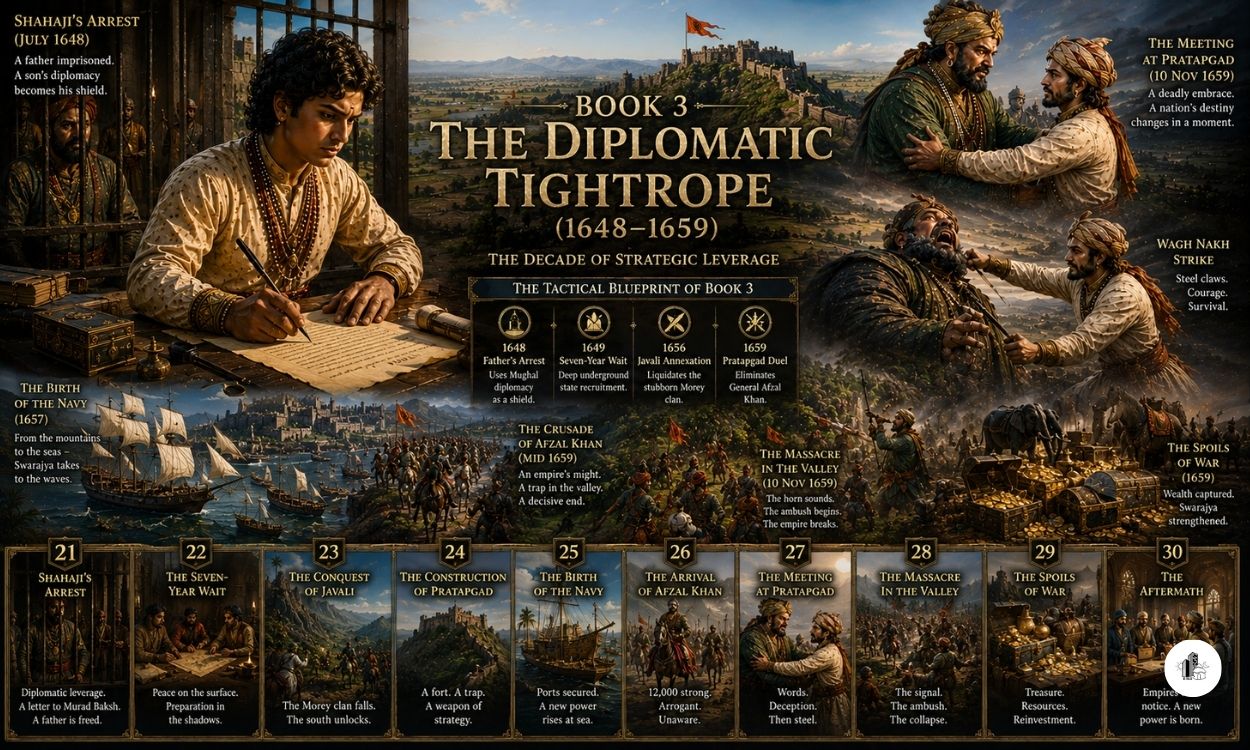
At precisely 1:30 PM on November 10, 1659, two men stepped into a silk tent at the base of Pratapgad Fort. One was a seven-foot tall imperial general carrying the full backing of the Adilshahi Sultanate. The other was a twenty-seven-year-old Maratha leader wearing concealed chainmail under a white cotton tunic.
Within five minutes, one man lay dead on the dirt floor. The other signaled a mass ambush that wiped out an entire invading army before sunset.

The Stage Setup: Designing the Psychological Trap
Afzal Khan did not climb up to Pratapgad because he wanted to talk. He climbed up because his 12,000-strong army was starving in the valley below.
Chhatrapati Shivaji Maharaj created a classic bottleneck in the dense Jawali forest. The imperial army could not deploy its 10,000 heavy cavalry among the steep cliffs. Supply lines broke down completely. Local village headmen (Patils) hid grain stores under strict orders backed by coastal land records (Mahazars). Common soldiers survived on emergency rations of dry Bhakri flatbread while horse fodder ran out.
Diplomatic envoys spent weeks setting the rules. Both leaders agreed to strict conditions to reduce suspicion:
Location: A temporary shamiana (silk pavilion) built on a cleared ridge below Pratapgad walls.
Escort Limits: Only ten armed bodyguards allowed per side, stationed 1,000 yards away.
Personal Presence: Only two personal envoys and one armed bodyguard inside the tent per leader.
Afzal Khan brought his trusted sword expert, Sayyid Banda. Chhatrapati Shivaji Maharaj brought his elite shield master, Jiva Mahala, and loyal captain Sambhaji Kavji.
“Wait, have you read this yet?”
Chapter 26: The Arrival of Afzal Khan – The “Anti-Shivaji” Crusade
Anatomy of the Armor: Concealed Weapons and Countermeasures
Neither man trusted the truce. Both commanders prepared for immediate violence inside the tent.
Afzal Khan relied on his superior physical reach and a hidden iron dagger called a Bichuwa tucked into his waist sash. He believed his stature alone gave him an unbeatable lethal advantage.
Chhatrapati Shivaji Maharaj took no chances. Primary records like the Jedhe Shakavali confirm he spent the morning preparing a multi-layered defense.
                  ┌──► Chilkhat (Concealed Chainmail Shirt)
  Shivaji Maharaj ├──► Topi (Iron Cap inside Turban)
   Defense Setup  ├──► Wagh Nakh (Steel Tiger Claws in Left Hand)
                  └──► Bichuwa (Curved Dagger in Right Sleeve)
The Five-Minute Breakdown: What Happened Inside the Tent
The meeting started with false courtesy. Afzal Khan opened his arms for a formal embrace (Aalingan).
As Shivaji Maharaj stepped forward, the Khan used his height to trap the young Maratha leader’s neck under his left arm. Simultaneously, Afzal Khan pulled his hidden dagger and drove it directly into Shivaji Maharaj’s side.
The heavy blade struck steel. Shivaji Maharaj’s hidden Chilkhat chainmail stopped the fatal stab completely.
Shivaji Maharaj reacted in a split second. He wrapped his left hand around Afzal Khan’s waist and drove his Wagh Nakh (steel tiger claws) directly into the general’s abdomen. With his right hand, he drew his own Bichuwa to complete the lethal strike.
| Tactical Phase | Afzal Khan’s Action | Shivaji Maharaj’s Counter-Action |
| Initial Contact | Feigned warm embrace to lock neck | Stood low, kept hands position-ready |
| First Strike | Dagger stab to Maratha torso | Chainmail absorbed blade impact |
| Lethal Turn | Held grip, called for Sayyid Banda | Disemboweled Khan with Wagh Nakh |
| Tent Escape | Wounded Khan dragged to palanquin | Jiva Mahala severed Sayyid Banda’s arm |
Afzal Khan collapsed, screaming for help. His palanquin bearers tried to carry him away, but Sambhaji Kavji cut them down outside the tent. Within minutes, the Bijapur general was dead.
Loving this analysis? Let’s stay connected!
Join our WhatsApp & Telegram Channels: Get the latest movie alerts and box office updates directly on your phone. [WhatsApp] & [Telegram]
Follow us on X (Twitter): For quick threads, daily polls, and viral cinema news. [Click Here]
Join our Quora Space: Participate in deep discussions and share your own theories with fellow movie buffs. [Click Here]
The Cannon Signal: Total Ambush in Jawali
The killing inside the tent was only the trigger. The true victory lay in the pre-planned ambush surrounding the valley.
Shivaji Maharaj ran up the path toward Pratapgad Fort and signaled his artillery master. A single cannon blast roared from the ramparts.
Hidden Maratha troops burst out of the dense foliage across the entire Jawali valley:
Kanhoji Jedhe led mountain infantry against the main Bijapur camp.
Moropant Pinglay blocked the escape routes toward Mahabaleshwar.
Netaji Palkar hunted down fleeing cavalry units on the lower plains.
The starving, leaderless imperial army disintegrated in hours. Maratha forces captured 65 war elephants, 4,000 horses, 1,200 camels, and the entire royal treasure chest.
Humanitarian Protocol: The Post-Battle Decree
In 17th-century warfare, victorious armies typically slaughtered or enslaved surrendered enemy troops. Shivaji Maharaj broke this rule completely.
He issued an immediate administrative order across the battlefield. Unarmed soldiers, surrendered troops, and women were not to be harmed.
Wounded enemy officers received medical treatment from Maratha physicians. Shivaji Maharaj paid travel expenses for captured soldiers who wished to return home to Bijapur. He even buried Afzal Khan with full military honors on the slope of Pratapgad, where the tomb stands today.
This strategic mercy won over local populations. It proved that Swarajya was not a lawless rebel group, but an organized state governed by law.
What Do You Think?
Was Shivaji Maharaj’s use of hidden weapons justified given Afzal Khan’s past record of betrayal? How would the political map of India look today if the chainmail had failed that afternoon?






Leave a Reply