

The Swarajya Chronicles: Book 2, Chapter 17
Current Focus: The Boy and the Vow (1630–1647)
Progress: 17 / 100 Chapters Completed….
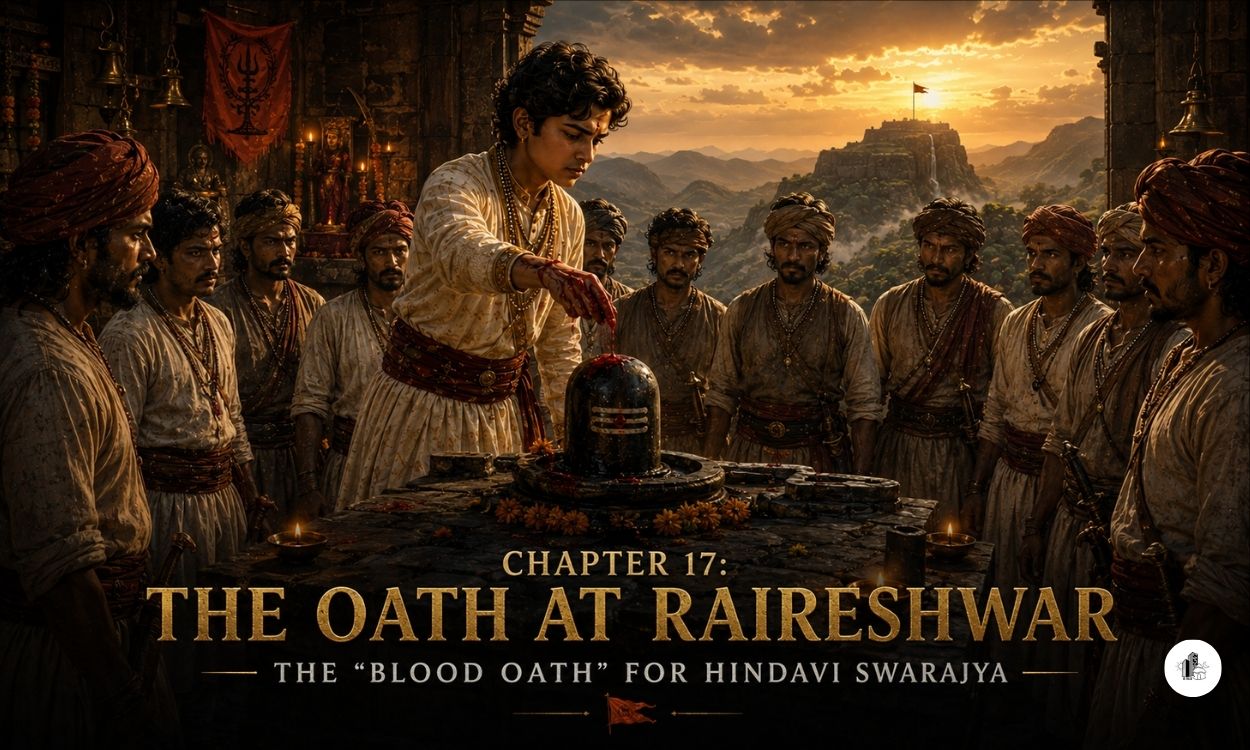
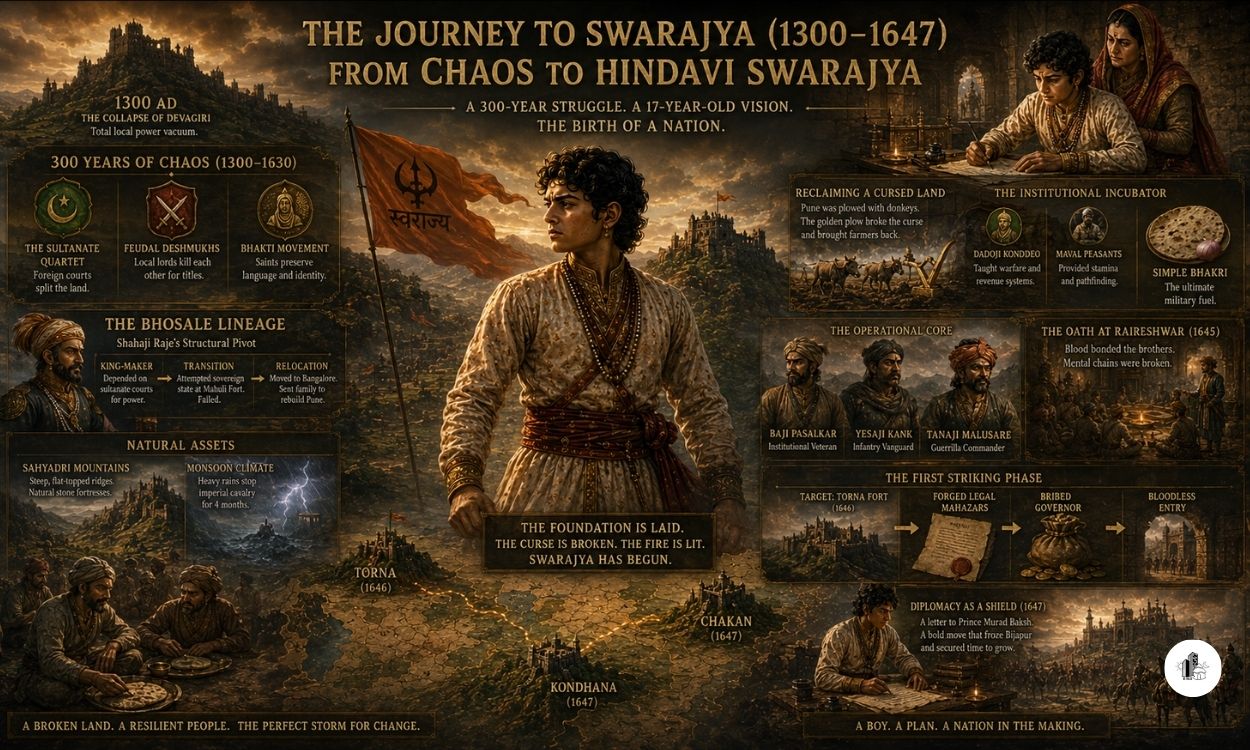
In April 1645, a tiny group of teenagers and young men slipped unnoticed into a secluded temple on a high, wind-swept plateau. They did not carry bags of gold, imperial permits, or official stamps from the Bijapur Sultanate. Instead, a 15-year-old Chhatrapati Shivaji Maharaj sliced open his own finger. He poured his flowing blood directly onto a stone Shivalinga.
This was no theatrical stunt. It was an act of high treason punishable by public execution. Under Deccani imperial law, this deliberate ritual cut the political threads connecting the Pune jagir to the ruling Adilshahi dynasty.
Contemporary references, including the Jedhe Shakavali and old family papers, document this calculated operational shift. This chapter dissects the cold, structural mechanics of the Raireshwar blood oath. It was a massive psychological operation that weaponized local religious networks to launch a sovereign state.
The Tactical Geography of the Raireshwar Plateau
Military movements succeed or fail based on their location. The young Shivaji Maharaj chose the temple of Raireshwar near Bhor after a careful study of regional geography.
Raireshwar Plateau: The Strategic Layout

▲ Altitude: ~4,500 Feet (Natural defensive wall)
■ Topography: Massive, flat basalt structure
► Location: Triple border junction (Pune, Satara, Mahad)
▼ Visibility: Hidden inside deep, cloud-covered valleys
The plateau sits nearly 4,500 feet above sea level. It features steep, vertical basalt cliffs that act as an unscalable, natural stone fortress. Heavy imperial cavalry units could not navigate the narrow, rocky tracks leading to the top. The temple itself sits deeply recessed into the mountain folds. Thick, subtropical forests completely shielded the arriving leaders from the eyes of patrolling sultanate scouts.
The site sat right at a strategic triple border junction. If an imperial garrison detected their presence, the conspirators could quickly scatter down three different mountain passes. They could vanish into the rugged Konkan coast, the dense Bhor valleys, or the deep Desh plains within hours.
“Wait, have you read this yet?”
Breaking the Mental Chains of the Vatandari System
The true enemy of independence was not the size of the Adilshahi army. The biggest obstacle was the deeply ingrained psychological conditioning of the local Maratha elite, known as Vatandars.
For generations, families like the Jedhes, Bandals, and Khopdes viewed themselves merely as imperial servants. They measured their entire social worth by their Vatan- hereditary land grants issued by foreign sultans. Local Mahazars (court records) show these clans spent decades slaughtering each other over petty boundary disputes. The sultanate routinely exploited these internal blood feuds to prevent unified local uprisings.
Imperial Vatandari vs. Hindavi Swarajya

Hereditary Land Grant (Vatan)  ►  Sovereign Homeland (Swarajya)
Servant to Foreign Sultans     ►  Radical Indigenous Equality
Divided Local Blood Feuds      ►  Unified Operational Core
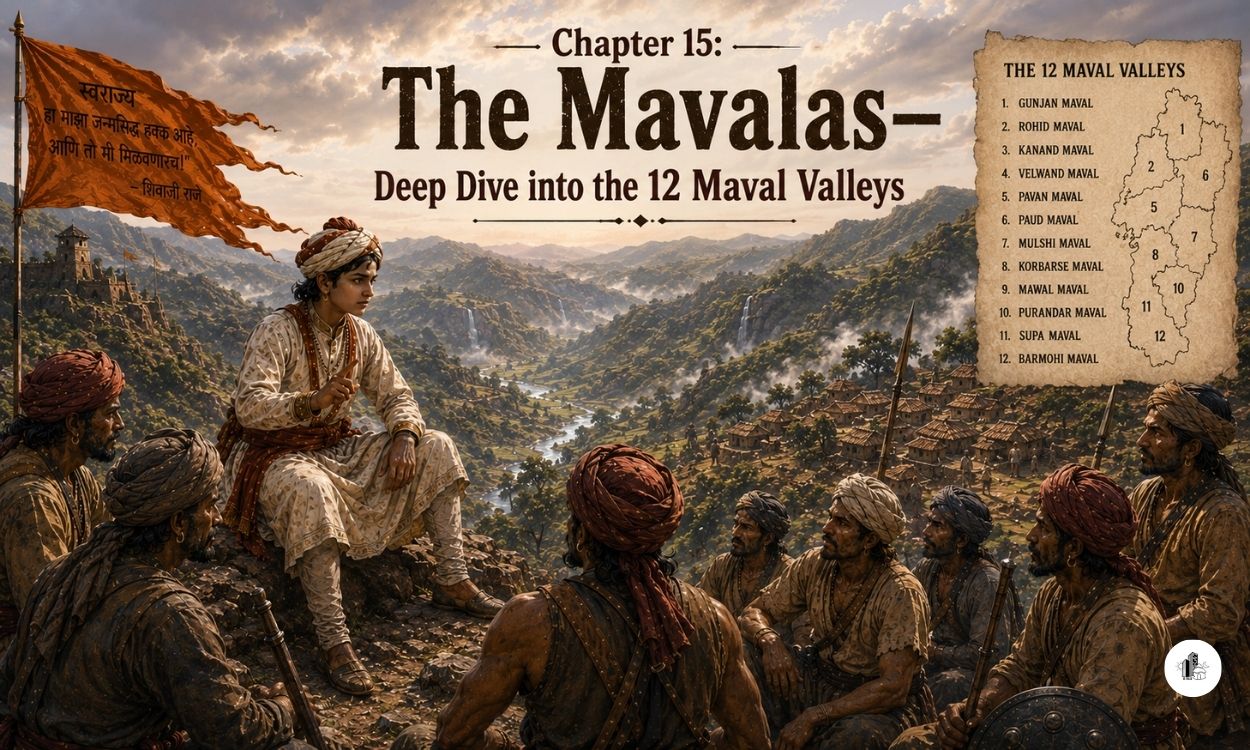
Chhatrapati Shivaji Maharaj recognized this deep systemic weakness. He knew he could not build an empire using simple political promises. Chhatrapati Shivaji Maharaj needed a radical, transcendent idea to break their mental dependence on the sultan’s court. He introduced the concept of Hindavi Swarajya- a sovereign, self-ruling territory. Also he deliberately framed the rebellion not as a personal grab for power, but as a divine mandate.
The Mechanics of the Blood Oath: Psychological Warfare
The ritual inside the dark stone sanctum of Raireshwar was a masterclass in psychological warfare. Chhatrapati Shivaji Maharaj did not just speak to his inner circle. He bound them together through an irreversible, sacred pact.
According to regional historical traditions, the young prince stated directly that the kingdom belonged to the divine, and they were merely the instruments of its creation.
By slicing his finger and offering his blood, the young prince turned an illegal political conspiracy into a sacred duty. In the 17th-century Deccani mind, breaking an oath signed in blood before a deity invited total spiritual destruction.
This single act immediately elevated the struggle far above a standard tax rebellion. It forced the young Mavalas to think beyond their individual village borders. They left the temple no longer acting as fragmented, regional hill farmers. They emerged as a fiercely unified, highly motivated ideological brotherhood.
Technical Analysis: The Strategic Execution Framework
The operational rollout following the Raireshwar oath reveals a modern, systematic approach to staging a successful regional insurgency:
Securing the Regional Landlords: The prince immediately sent formal, confidential letters to key valley chieftains, using the newly forged oath to demand absolute operational unity.
Securing Choke Points: The core team quietly mapped out the immediate mountain strongholds, targeting critical gateways like Torna and Chakan for quick acquisition.
The Silent Recruitment Drive: Local recruiters utilized the sacred momentum of the oath to mobilize thousands of youth across the 12 Maval valleys without alerting local tax collectors.
Economic Non-Cooperation: The movement began laying the groundwork to redirect local agricultural revenue away from the Bijapur treasury, using it instead to fund internal weapon production.
Loving this analysis? Let’s stay connected!
Join our WhatsApp & Telegram Channels: Get the latest movie alerts and box office updates directly on your phone. [WhatsApp] & [Telegram]
Follow us on X (Twitter): For quick threads, daily polls, and viral cinema news. [Click Here]
Join our Quora Space: Participate in deep discussions and share your own theories with fellow movie buffs. [Click Here]
The Real-World Primary Evidence
Skeptics often dismiss the Raireshwar oath as a late historical myth. However, real-world primary documents firmly validate the radical political shift that occurred in the spring of 1645.
A highly specific, contemporary letter written by Chhatrapati Shivaji Maharaj to Dadaji Naras Prabhu Khopde provides undeniable proof. In this authentic document, the young prince explicitly references the oath taken before the deity at Raireshwar. He writes boldly about their shared commitment to establishing a self-governing state.
This letter was not a romantic poem. It was a serious, highly dangerous piece of political correspondence. It proves that a 15-year-old youth possessed the immense strategic clarity to define, execute, and document a sovereign revolution.
The Point of No Return
When the small group walked out of the temple into the cold mountain air, they left their old lives behind. They had committed the ultimate act of political defiance against a massive, nuclear-equivalent medieval superpower. There was no room for second-guessing, and there was no turning back.
The blood drying on the stone altar signaled the start of a massive, multi-generational geopolitical shift. The fractured, warring clans of the Deccan now possessed a single, unyielding focus. The young prince had provided the vision, the mountains provided the shield, and the blood oath provided the iron-clad will to fight.
What Do You Think?
Do you think a successful movement requires a deep, sacred, or ideological bond to survive major hardships, or can shared economic interests achieve the exact same results? If you were a local landlord in 1645, would you have risked your legal estate to join a highly dangerous blood oath led by a 15-year-old prince?







Leave a Reply