

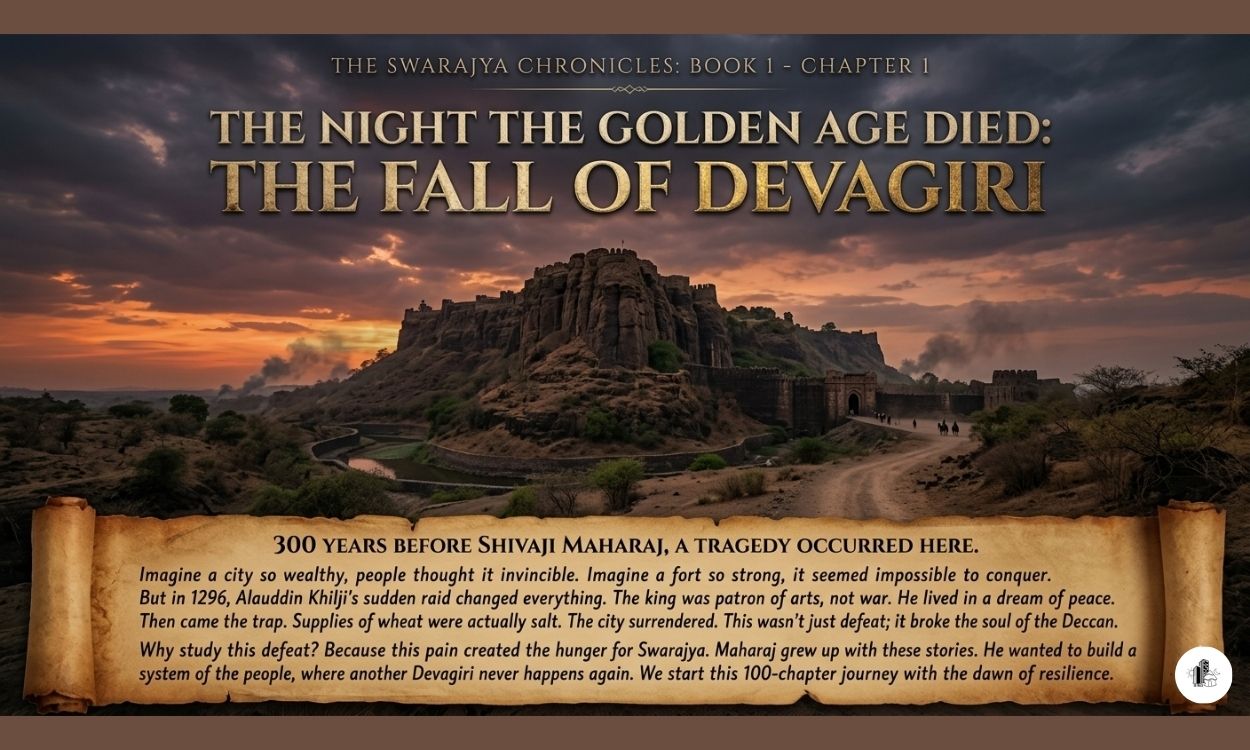
The Swarajya Chronicles: Book 1, Chapter 1
Current Focus: The Pre-Swarajya Landscape (1300 – 1630)
Progress: 01 / 100 Chapters Completed
Imagine a city so wealthy that its walls seemed to sweat gold. Imagine a fort so strong that people believed it was impossible to conquer. This was Devagiri, the heart of the Yadav Empire. In the year 1296, the people here felt safe. They had food, art, and thousands of years of culture. They did not know that a storm was coming from the North. This storm would not just take their gold. It would break the soul of the Deccan for three centuries.
This is the very first step of our journey. To understand why Shivaji Maharaj had to build a new world, we must first see how the old one was destroyed. This is the “Zero Point” of our story.
The Fortress of the Gods
Devagiri was not just a capital city. It was a marvel of engineering. The fort sat on a massive, vertical rock. It had deep moats filled with crocodiles. It had complex tunnels that would trap any enemy. The Yadav kings were proud of this defense. They believed the Sahyadri mountains were their eternal protectors.
Because of this pride, they became comfortable. They stopped looking at the borders. They forgot that even the strongest wall needs a watchful eye. The king, Ramachandra Yadav, was a patron of the arts. He was a good man, but he was not ready for a new kind of war. He was living in a dream of peace.
The Sudden Storm: Alauddin Khilji’s Raid
In 1296, a young and ambitious commander named Alauddin Khilji did something unthinkable. Khilji marched from Delhi with only 8,000 horsemen. He did not declare war, just moved fast and kept his mission a secret. Khilji told everyone he was a rebel fleeing from his own uncle. This was a masterclass in psychological warfare.
When he reached the gates of Devagiri, the city was in shock. The main Yadav army was away with the crown prince. The fort had plenty of gold, but it lacked one thing: Grain. In a tragic mistake, the bags they thought were filled with wheat were actually filled with salt.
The Trap: The city was surrounded before the King could react.
The Bluff: Khilji lied and said a massive army of 20,000 was right behind him.
The Surrender: Fearing total destruction, King Ramachandra signed a treaty.
“Wait, have you read this yet?“
The Swarajya Chronicles: Why We Are Rebuilding the Story of a King
The Price of Silence
The wealth taken from Devagiri was staggering. Historians say it took thousands of camels to carry the gold and jewels back to Delhi. But the real price was not paid in gold. It was paid in dignity.
After this raid, the Yadavs became a “vassal” state. They were no longer independent. They had to pay a yearly tax to the Sultanate. This was the beginning of the end. By 1317, the Yadav dynasty was completely wiped out. The once-great empire was now just a memory. The “Golden Age” of the Marathi people had officially turned into a “Dark Age.”
The Onset of the Dark Ages
When Devagiri fell, the entire socio-political structure of Maharashtra collapsed. This is a “Minor Detail” that people often miss. It wasn’t just about a new king sitting on a throne. It was about a complete change in how people lived.
Loss of Patronage: The great poets and scholars lost their support.
Destruction of Temples: Many cultural centers were destroyed.
Foreign Administration: Governors from the North did not understand the local culture.
High Taxes: The common farmer was squeezed to pay for the Sultan’s wars.
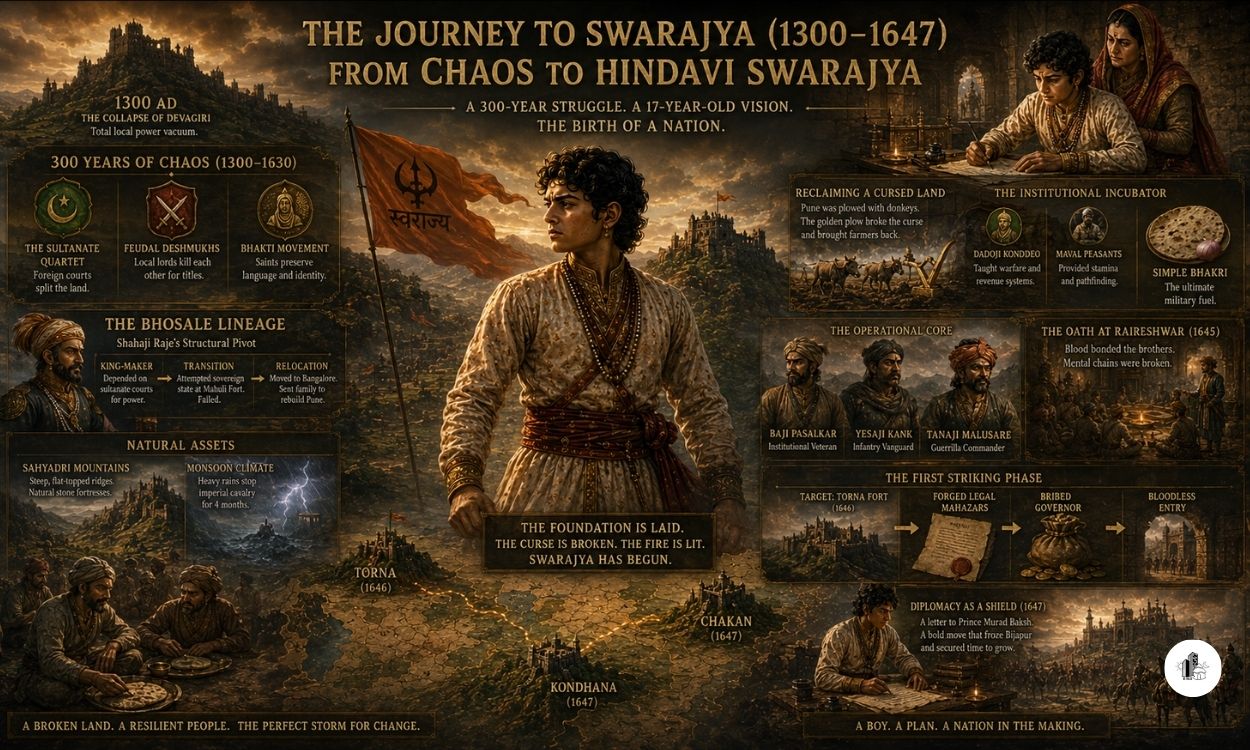
For the next 300 years, the land of the Sahyadris became a battlefield for foreign powers. The local leaders, the Deshmukhs, started fighting each other to please their new masters. The sense of “Unity” was gone. The people felt like orphans in their own home.
Why Does This Matter for Swarajya?
You might wonder why we are spending time on a defeat. It is because the pain of Devagiri is what created the hunger for Swarajya. You cannot appreciate the light of a lamp without knowing the darkness of the night.
Chhatrapati Shivaji Maharaj grew up listening to these stories. Ra heard about the lost glory of the Yadavs. He saw the broken temples. He saw how the local people had become servants. This “historical trauma” was the fuel for his fire. He didn’t just want to be a king. He wanted to ensure that another “Devagiri” never happened again.
The Landscape of Fear
By the 1600s, the Sultanates had carved up the Deccan: the Adil Shahi ruled the south, while the Nizam Shahi controlled the north. The common people lived caught in the crossfire. In this world, life was cheap, and no law protected the ordinary man.
This brutal environment forged a “Genetics of Rebellion.” Three centuries of desperation pushed the people to the edge, forcing them to seek an escape. They waited for a spark—but first, the land itself required preparation.
Loving this analysis? Let’s stay connected!
Join our WhatsApp & Telegram Channels: Get the latest movie alerts and box office updates directly on your phone. [WhatsApp] & [Telegram]
Follow us on X (Twitter): For quick threads, daily polls, and viral cinema news. [Click Here]
Join our Quora Space: Participate in deep discussions and share your own theories with fellow movie buffs. [Click Here]
What Do You Think?
The fall of Devagiri is a story of how overconfidence can destroy a nation. It shows that wealth is useless if you don’t have the strategy to protect it.
-
Do you think the Yadavs could have saved Devagiri if they weren’t so comfortable?
-
Does this remind you of any modern leadership failures?
We have just finished the first chapter of our 100-chapter journey. The next stop? We decode the Sultanate Quartet—the four powers that ruled after the Yadavs. We will see how they fought over our land and what it meant for the common man.
















Leave a Reply