
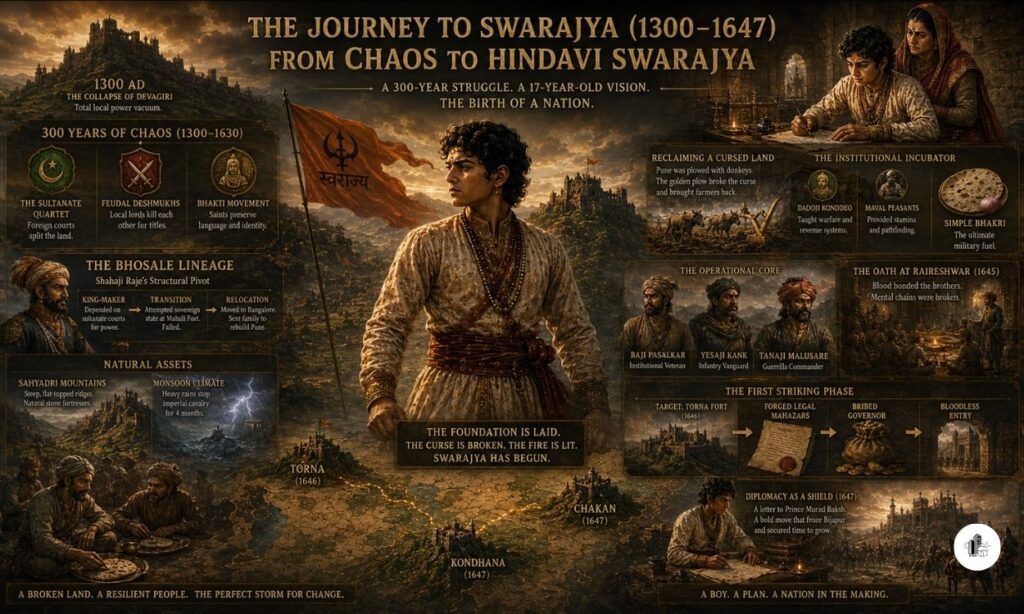
In 1300 AD, the wealthy Yadav Empire of Devagiri collapsed within a few weeks due to terrible military planning. For the next 300 years, no local ruler controlled the Deccan plateau of India. Foreign sultanates divided the land, collected the taxes, and used local soldiers to fight their endless private wars.
By 1647, a seventeen-year-old boy named Shivaji Bhosale had successfully forced the massive Mughal Empire to read his diplomatic letters. He did not achieve this through magic or luck. He used geography, psychology, and structural administrative loopholes.
This mega-review connects the pieces of our journey across Book 1 and Book 2. We map out exactly how a broken, war-torn region became the birthplace of a powerful sovereign state known as Hindavi Swarajya.
“Wait, have you read this yet?”
Chapter 20: The First Mughal Interaction- Early Letters to Empire
Book 1: The Pre-Swarajya Landscape (Past & Roots)
The foundation of any rebellion is laid centuries before the first sword is drawn. Book 1 focused on the deep systemic structures, regional families, and geographic conditions that made the Maratha uprising possible.
300-Year Chaos Matrix (1300–1630)
─────────────────────────────────
1300 AD: The Collapse of Devagiri (Total local power vacuum)
  │
  ├─► The Sultanate Quartet (Foreign courts split the land)
  ├─► Feudal Deshmukhs (Local lords kill each other for titles)
  └─► Bhakti Movement (Saints preserve language and identity)
The Foundations of Chaos
The fall of Devagiri created a massive local power vacuum. Soon, foreign sultanates like the Adilshahi of Bijapur and the Nizamshahi of Ahmednagar took control.
These courts did not run the villages directly. Instead, they relied on local feudal lords called Deshmukhs. Old legal court papers, known as Mahazars, reveal that these Deshmukh clans spent decades killing each other over petty village borders. The sultanates happily encouraged these blood feuds to prevent local unity.
Meanwhile, the cultural identity of the people survived through the Bhakti Movement. Local saint-poets used simple Marathi songs to keep the regional language and a sense of human equality alive among the common peasants.
The Rise of the Bhosale Lineage
Out of this chaotic feudal landscape rose the Bhosale family of Verul. Shivaji’s father, Shahaji Raje, was a brilliant military general and diplomat.
Shahaji Raje's Structural Pivot
───────────────────────────────
[Phase 1: King-Maker]  ► Depended on sultanate courts for power.
[Phase 2: Transition]  ► Attempted sovereign state at Mahuli Fort. Failed.
[Phase 3: Relocation]  ► Moved to Bangalore. Sent his family to rebuild Pune.
Shahaji Raje became a powerful “King-maker” in the Deccan. During the brutal Mahuli struggle, he tried to run a puppet kingdom to challenge both the Mughals and Bijapur. The attempt failed against the massive combined numbers of his enemies. Consequently, the sultanate forced Shahaji to move far south to Bangalore.
However, Shahaji Raje did something critical before leaving. He sent his wife, Jijau Maa, and his young son, Shivaji, back to their ancestral land in Pune. Maa Jijau was the daughter of the proud Jadhav clan of Sindkhed Raja. She understood the internal structural rot of the sultanates. She became the primary architect of her son’s mind, teaching him to despise serving foreign courts.
Natural Assets: Terrain and Weather
The Marathas possessed a silent, powerful ally: the Sahyadri mountain range.
The unique volcanic basalt mountains featured steep, flat-topped ridges. These heights were perfect for building natural stone forts. Furthermore, the brutal 17th-century monsoon climate completely dictated medieval warfare. Heavy rains turned roads into thick mud, stopping imperial cavalry movements for four months every year.
Book 2: The Boy and the Vow (1630–1647)
Book 2 tracked the transformation of an idea into a concrete political reality. It focused on the childhood, training, and tactical first strikes of the young prince.
Reclaiming a Cursed Land
Shivaji Maharaj was born on February 19, 1630, inside the secure fort of Shivneri. He spent his early childhood fleeing military raids.
When he finally returned to Pune as a young boy, he found a completely ruined town. The Bijapur Sultanate had literally plowed the city with donkeys and driven a massive iron crowbar into the soil as a curse. Shivaji Maharaj’s administration answered this psychological warfare with an inspiring counter-move. They used a symbolic golden plow to turn the soil, breaking the curse and inviting the frightened farmers back to their fields.
The Institutional Incubator
───────────────────────────
[Dadoji Konddeo]  ► Taught weapon handling and strict revenue accounting.
[Maval Peasants]  ► Provided raw mountain stamina and elite pathfinding.
[Simple Bhakri]   ► The ultimate low-cost, high-energy military fuel.
The veteran administrator Dadoji Konddeo stepped in to train the boy. He provided lessons in sword fighting, horse riding, and strict tax bookkeeping.
The Operational Core
The true muscle of the young movement came from the 12 Maval valleys. The local peasants, known as Mavalas, were incredibly hardy men. They survived on a simple daily diet of coarse millet Bhakri flatbread and raw onions.
| The First Circle | Primary Operational Role | Strategic Contribution |
| Baji Pasalkar | Institutional Veteran | Provided mature, elder authority to the youth movement. |
| Yesaji Kank | Infantry Vanguard | Represented the raw physical power of the Maval scouts. |
| Tanaji Malusare | Guerrilla Commander | Mastered high-speed stealth and night-climbing tactics. |
In April 1645, this young group gathered at the secluded temple of Raireshwar. Shivaji sliced open his own finger and poured his blood onto a stone Shivalinga. This literal blood oath was an act of extreme high treason. It completely smashed the mental dependence on foreign titles, turning local hill farmers into a unified ideological brotherhood.
The First Striking Phase
The group moved fast after the oath. In 1646, the sixteen-year-old prince pulled off a brilliant bureaucratic heist to capture Torna Fort.
[Target: Torna Fort] ──► [Forged Legal Mahazars] ──► [Bribed Governor] ──► [Bloodless Entry]
Shivaji Maharaj’s agents used forged legal documents and bags of gold coins to convince the lonely, underfunded Adilshahi governor to step down. The gates opened without a single drop of blood being spilled. Shivaji used the hidden tax gold found inside Torna’s walls to build the nearby fortress of Rajgad.
In 1647, he locked down the entire Pune jagir by capturing the northern plain gate of Chakan and the southern mountain shield of Kondhana.
Finally, by late 1647, the teenager opened a direct line of communication with Mughal Prince Murad Baksh. He used the fear of a northern invasion to freeze the Bijapur Sultanate from retaliating against him.
Loving this analysis? Let’s stay connected!
Join our WhatsApp & Telegram Channels: Get the latest movie alerts and box office updates directly on your phone. [WhatsApp] & [Telegram]
Follow us on X (Twitter): For quick threads, daily polls, and viral cinema news. [Click Here]
Join our Quora Space: Participate in deep discussions and share your own theories with fellow movie buffs. [Click Here]
The Journey Continues
Book 1: The Landscape |
Book 2: The Action |
| Explored 300 years of broken regional structures. | Witnessed the implementation of the Swarajya blueprint. |
| Highlighted the natural defense of basalt mountains. | Saw the operational capture of key valley choke points. |
| Showed how local clans wasted energy on feuds. | Bound those clans together via a binding blood oath. |
Book 1 and Book 2 have shown us the complete setup of the Maratha nation. The young prince has successfully turned a vulnerable, cursed estate into a heavily protected mountain shield. The foundation is ready. The structural machinery is ticking. Book 3 will bring us face-to-face with the true fury of the imperial courts.
What Do You Think?
Looking back at the entire journey from 1300 to 1647, which factor do you think was the most critical for Shivaji’s early success? Was it the natural shield of the Sahyadri mountains, the cultural survival through the Bhakri-eating Mavala infantry, or his own brilliant use of faking imperial bureaucracy?