
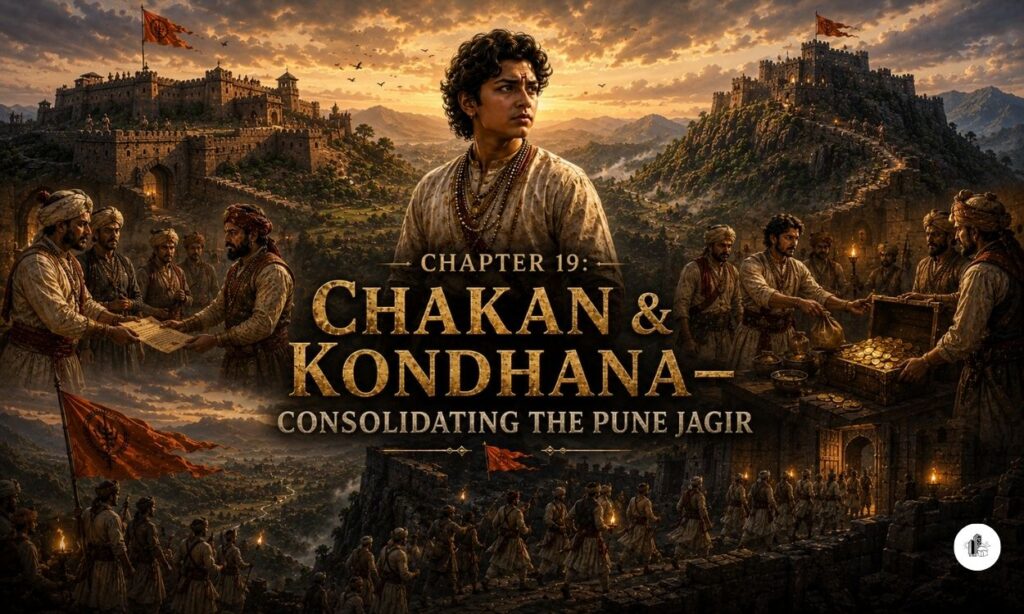
The Swarajya Chronicles: Book 2, Chapter 19
Current Focus: The Boy and the Vow (1630–1647)
Progress: 19 / 100 Chapters Completed….
In 1647, young Shivaji Maharaj effectively trapped the local governors of two major military outposts without declaring open war. He did not use massive siege weapons. He did not march thousands of brightly dressed soldiers across the open plains. Instead, he studied the local tax registers and geographic data. He used these details to choke the supply lines of his targets.
Capturing Torna Fort was a brilliant opening move. However, one isolated mountain peak cannot secure a whole region. The Adilshahi Sultanate of Bijapur still held two massive security gates on the borders of the Pune district. These gates were Chakan Fort in the north and Kondhana Fort in the south.
   [Chakan Fort]  ◄── (Northern Lowland Gate)
         │
   [Pune Valley]  ◄── (The Vulnerable Center)
         │
 [Kondhana Fort]  ◄── (Southern Mountain Guard)
Historical records like the Jedhe Shakavali show that leaving these forts in foreign hands meant the infant Maratha state could be crushed at any moment. Chhatrapati Shivaji Maharaj needed to control both outposts to lock down his family’s ancestral lands, known as the Pune jagir. He chose to use local politics, money, and structural pressure to secure these forts.
The Northern Door: Subduing Chakan Fort
Chakan Fort sat on the flat plains directly north of Pune. It was not a mountain fortress. It was a land-level mud and stone structure surrounded by a deep water ditch.
This specific design made it a direct threat. Heavy imperial cavalry units from Bijapur or Delhi could use Chakan as a secure basecamp. From there, they could easily raid the flat farming villages of the Pune valley. The fort commander was an experienced veteran named Firangoji Narsala. He held a formal imperial commission from the Sultan.
Chhatrapati Shivaji Maharaj did not waste human lives on a risky frontal charge across an open ditch. He understood that Firangoji was a local man of the soil, not a foreign officer.

The Soft Approach: Chhatrapati Shivaji Maharaj sent trusted local diplomats to meet Firangoji in private.
The Legal Argument: They did not threaten his life. Instead, they showed him old land papers, known as Mahazars, to prove Chhatrapati Shivaji Maharaj’s legal right to manage the region.
The Better Offer: Chhatrapati Shivaji Maharaj offered him a permanent, respected position in the new home-grown administration.
Firangoji looked at the changing local political landscape. He realized that the distant central government in Bijapur rarely sent salaries or repair funds for the fort walls. Firangoji chose to switch his loyalty. He handed over the keys to Chakan without a single drop of blood being spilled. Chhatrapati Shivaji Maharaj immediately returned the fort to Firangoji’s command under the new flag of Swarajya.
“Wait, have you read this yet?”
The Southern Shield: Buying Kondhana Fort
Securing the north was only half the job. The massive mountain fortress of Kondhana loomed heavily over the southern horizon of Pune.
Kondhana sat on a rugged basalt cliff over 4,300 feet high. It was a natural military monster. A small defensive garrison at the top could easily spot an incoming army from miles away. The fort governor was an Adilshahi loyalist named Sidi Ambar. Unlike the commander at Chakan, Sidi Ambar could not be easily convinced by legal arguments or local family ties.
| Operational Target | Chakan Fort | Kondhana Fort |
| Geographic Location | Northern Lowlands | Southern Mountain Peak |
| Fort Architecture | Mud & Stone Plain Fort | Basalt Rock Mountain Fort |
| Adilshahi Commander | Firangoji Narsala | Sidi Ambar |
| Takeover Method | Diplomatic Alignment | Financial & Structural Bribery |
| Strategic Outcome | Blocks Plain Cavalry Raids | Secures Southern Mountain Shield |

Chhatrapati Shivaji Maharaj used a different vulnerability: institutional greed. The garrison soldiers inside Kondhana were lonely and poorly paid. They survived on simple local meals of coarse Bhakri flatbread and wild vegetables. They felt completely forgotten by the rich nobles living in distant capital cities.
Chhatrapati Shivaji Maharaj sent secret agents into the mountain paths around the fort. These agents carried heavy leather bags filled with gold coins. They systematically bribed the senior guards and the governor himself. In 1647, the gates opened from the inside under the cover of night. Shivaji’s light infantry units quietly marched up the steep tracks and took over the battlements.
Loving this analysis? Let’s stay connected!
Join our WhatsApp & Telegram Channels: Get the latest movie alerts and box office updates directly on your phone. [WhatsApp] & [Telegram]
Follow us on X (Twitter): For quick threads, daily polls, and viral cinema news. [Click Here]
Join our Quora Space: Participate in deep discussions and share your own theories with fellow movie buffs. [Click Here]
The Structural Impact on the Pune Jagir
By taking Chakan and Kondhana, the seventeen-year-old prince completed a brilliant strategic checkmate. Chhatrapati Shivaji Maharaj changed how power worked in the region.
He did not just capture stone walls. He secured the entire agricultural tax revenue of the surrounding valleys. Previously, local wealth left the province to fund luxury lifestyles in distant imperial cities. Now, every grain of harvest stayed within the territory to pay local workers and buy weapons.
The regional landlords, known as Vatandars, observed this massive change with deep interest. They realized that the young boy was systematically building a safe, well-governed zone. He protected the common farmers from sudden foreign raids. He established a clean, visible administration right at their doorsteps.
Locking Down the Borders
The double capture of Chakan and Kondhana marked the true end of the open, undefended Pune frontier. The young leader successfully turned a weak, vulnerable family estate into a highly defenseless mountain shield.
The imperial officials in Bijapur finally began to realize that something dangerous was happening on their western borders. They looked at their regional maps and saw a growing cluster of forts under a new, unauthorized command. However, their administrative reaction came too late. The northern plains were secure, the southern mountain peaks were locked, and the foundations of a sovereign nation were firmly set in stone.
What Do You Think?
Do you think it is smarter for a leader to use diplomatic persuasion like at Chakan, or financial strategy like at Kondhana, to solve a major conflict? If you were a local soldier in 1647, would you stay loyal to a distant empire or support a young local leader building a secure homeland?