
The Swarajya Chronicles: Book 1, Chapter 10
Current Focus: The Pre-Swarajya Landscape (1300–1630)
Progress: 10 / 100 Chapters Completed….
Welcome to the final chapter of Book 1. We have traveled through time, politics, and rugged mountains. Now, we face the most powerful force of all: Nature. Imagine being a soldier in 17th Century. You are far from home, sleeping in a thin tent. Suddenly, the sky turns black. The rain starts falling like a thousand hammers. Within minutes, the ground turns into thick mud. Your heavy boots get stuck. Your expensive gunpowder becomes wet and useless. In the 17th century, a general could plan for everything except the Indian Monsoon.
This chapter looks at how the weather was the ultimate judge in the Deccan wars. Shivaji Maharaj did not just survive the rain. He used the clouds as a strategic shield for his Swarajya blueprint. While empires paused, he moved forward.
The Monsoon: A Natural Ceasefire
In the 1600s, the Indian monsoon was a massive wall. Most armies in the world fought only during “the season.” This season usually started in October and ended in May. When the first rains hit in June, everything stopped. The Mughal Empire and the Adilshahi had a simple rule. You go back to your base and wait for the sun.
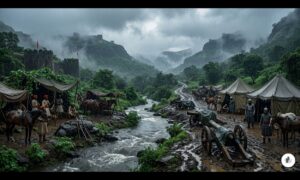
Why did they stop? Their armies relied on thousands of horses and bullocks. These animals cannot march through deep mud. Their heavy wooden carts would sink into the earth. If an army got stuck in the rain, they would starve. They could not move food to the front lines. Therefore, the rain dictated the start and end of every war. It was a forced peace treaty written in the sky.
Gunpowder vs. Tropical Humidity
The biggest problem for the 17th-century soldier was the “matchlock.” To fire, you needed a burning string called a match. You also needed dry gunpowder. During the Deccan monsoon, the air is thick with water.
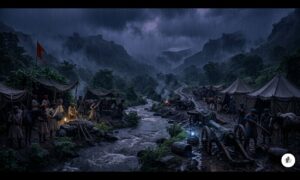
Mughal found their powder would not light. Their cannons became big piles of useless metal. Humidity was a silent enemy that disarmed the most powerful armies. However, Shivaji Maharaj changed his tactics. He focused on hand-to-hand combat during the wet months. He knew his Mavala warriors were masters of the sword and shield. They did not need dry powder to win a battle in the dark. They only needed a steady foot on the slippery rocks.
“Wait, have you read this yet?“
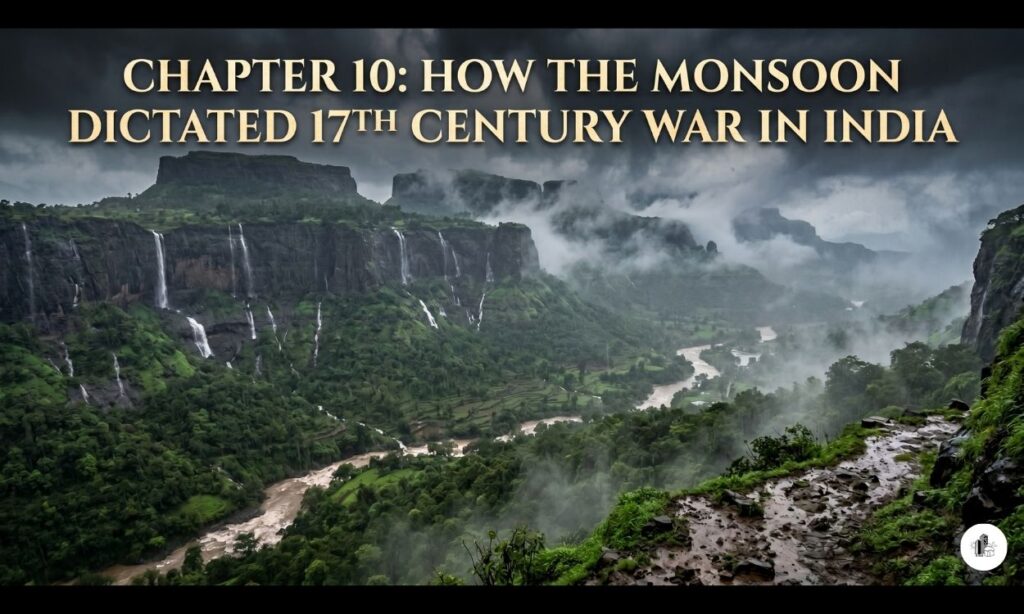
Chapter 10: How the Monsoon Dictated 17th Century War in India
Chapter 9: Geography as a Weapon- The Secrets of the Sahyadri Mountains
The “Biological War” of the Rain
Rain brings life, but it also brings death in a camp. Huge armies of 100,000 soldiers create a lot of waste. When the rain falls, this waste mixes with the drinking water. During the 17th century, more soldiers died from fever and flux than from swords.
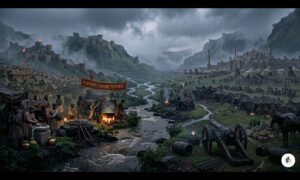
The Mughal camps were like giant moving cities. They were very unhygienic in the mud. Diseases like cholera and malaria would rip through their ranks. Shivaji Maharaj kept his army small and mobile. He did not build giant camps. His men stayed in high-altitude forts where the water was fresh and moving. He used the climate to make the enemy sick while his men stayed strong. This was a key part of his geopolitical shift in power.
Strategic Analysis: Climate-Driven Asymmetric Warfare
How did the weather help create a new type of warfare? It allowed for a style of fighting that the big empires hated. Let us look at the technical strategic advantages.
Logistical Paralysis of the Enemy: The rain turned the Deccan roads into traps. The Mughals could not bring in reinforcements or gold. This left their distant outposts vulnerable.
The “Shadow Movement” Strategy: In the heavy fog of the Sahyadris, visibility is zero. Shivaji Maharaj used this “white curtain” to move his troops unseen. They would appear at a fort gate like ghosts from the mist.
Tactical Flooding: The Marathas understood the river patterns. They knew which rivers would flood and when. They used these rising waters to cut off the enemy’s path of retreat.
Economic Resilience: The Maratha soldiers were often farmers too. They would fight in the dry season and plant crops during the rains. This made the Swarajya economy very stable.
This was not just fighting; it was Climate Intelligence. Shivaji Maharaj viewed the monsoon as a time of opportunity, not a time of rest.
Loving this analysis? Let’s stay connected!
Join our WhatsApp & Telegram Channels: Get the latest movie alerts and box office updates directly on your phone. [WhatsApp] & [Telegram]
Follow us on X (Twitter): For quick threads, daily polls, and viral cinema news. [Click Here]
Join our Quora Space: Participate in deep discussions and share your own theories with fellow movie buffs. [Click Here]
The End of Book 1: The Pre-Swarajya Landscape (Past & Roots): A New Era Begins
As we close this first book, we see the foundation is ready. We have seen the family history of the Bhosales. Also have felt the strategic hand of Shahaji Raje, Maa Jijau. We have walked the vertical cliffs of the Sahyadri. And now, we understand how the rain and the sun shaped the battles.

By 1645, the pieces were on the board. The young Shivaji Maharaj was no longer just a boy with a dream. He was a leader who understood the land, the people, and the sky. He was ready to challenge the greatest empires on earth. The Swarajya blueprint was moving from paper to the battlefield.
Tell us which chapter do you like the most!!
What Do You Think?
Do you think modern wars are still affected by the weather, or has technology fixed that? Imagine you are a Mughal soldier stuck in the Deccan mud—would you desert the army or stay and fight? Finally, do you think the Indian Monsoon was the most important ally of the Marathas?