
The Swarajya Chronicles: Book 3, Chapter 21
Current Focus: The Boy and the Vow (1648–1659)
Progress: 21 / 100 Chapters Completed….
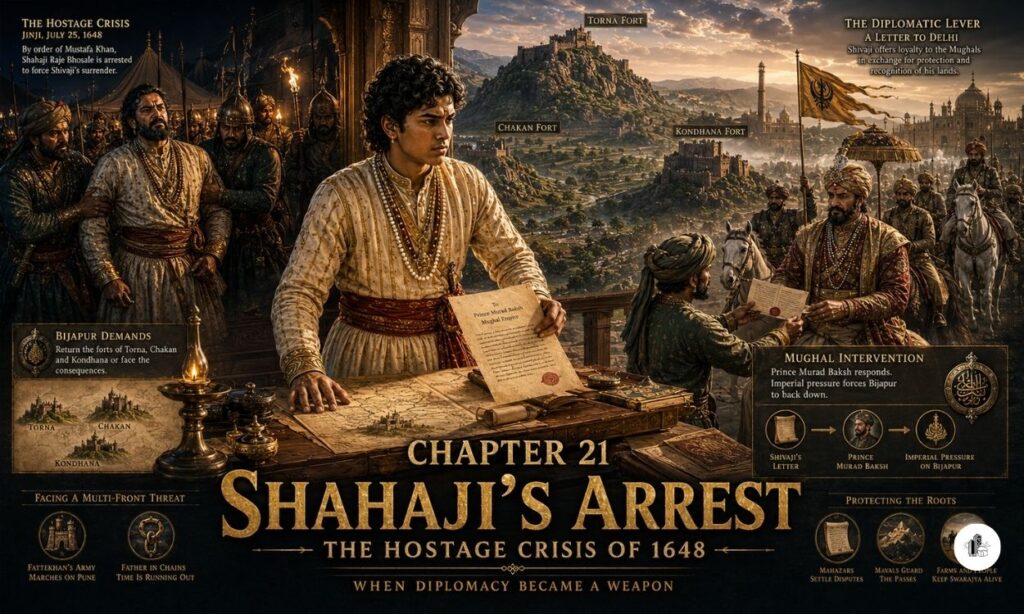
On July 25, 1648, imperial soldiers surrounded a military tent near Jinji. They moved silently under the cover of night. On the orders of Mustafa Khan, the top commander of the Adilshahi Sultanate, they arrested Shahaji Raje Bhosale.
The court of Bijapur was terrified of the rapid expansion of the young rebel, Shivaji Bhosale, in the Pune jagir. They could not stop him on the battlefield. Instead, they took his father hostage to force a complete surrender.
Most teenage rebels would have panicked. They might have handed over their hard-won mountain forts out of pure emotion. However, eighteen-year-old Shivaji Maharaj chose a colder, far more calculating path. He weaponized imperial paper, playing the two biggest superpowers of India against each other.
The Anatomy of a Hostage Crisis
The arrest of Shahaji Raje was a massive political shockwave. The Adilshahi court kept him in tight chains. They demanded that Chhatrapati Shivaji Maharaj return Torna, Chakan, and Kondhana immediately.
[Adilshahi Sultanate] ─── Holds Hostage ───► [Shahaji Raje]
        │                                         ▲
  Demands Forts                             Shivaji Protects
        │                                         │
        ▼                                         │
 [Shivaji Bhosale] ─── Diplomatic Leverage ───────┘
Historical primary sources like the Jedhe Shakavali show that the situation was desperate. At the exact same time, a Bijapur army under Fattekhan marched directly toward Pune. They wanted to crush the young movement while it was distracted and hurting.
Chhatrapati Shivaji Maharaj faced a brutal, multi-front dilemma. If he fought the incoming army, the Sultan might execute his father in jail. If he surrendered his forts, the dream of Swarajya would die permanently.
“Wait, have you read this yet?”
The Grand Diplomatic Lever: Writing to Delhi
Chhatrapati Shivaji Maharaj looked north toward the Mughal Empire. He recognized a critical administrative blind spot in the Deccan.
The Mughal Emperor, Shah Jahan, and his son, Prince Murad Baksh, were desperate to conquer the southern sultanates. Chhatrapati Shivaji Maharaj decided to exploit this geopolitical hunger. He bypassed his immediate rulers completely. He sent an urgent, highly formal letter straight to Prince Murad Baksh.
The Art of the Counter-Threat
Chhatrapati Shivaji Maharaj did not beg the Mughals for a rescue army. Instead, he made an official diplomatic offer.
The Offer: He stated that he and his entire family were ready to join the Mughal service.
The Price: He requested official Mughal protection for his father and imperial validation of his lands.
The Hidden Trap: By offering to become a Mughal vassal, Shivaji technically turned his territory into Mughal property.
Authentic Persian letters preserved in the historical collection Adab-i-Alamgiri confirm that the Mughal court took this offer very seriously.
[Shivaji's Letter] ───► [Prince Murad Baksh] ───► [Imperial Pressure on Bijapur]
Prince Murad Baksh quickly sent an imperial reply. He promised to protect the Bhosale family. This response completely changed the terms of the crisis.
The Strategy of Freezing the Sultan
This move was a masterpiece of psychological warfare. The Adilshahi Sultanate suddenly found themselves trapped in a dangerous diplomatic corner.
| The Actor | Original Position | The Shift After Mughal Intervention |
| Bijapur Sultanate | Wanted to execute Shahaji and crush Pune. | Feared an immediate, massive Mughal invasion from the north. |
| Mughal Empire | Was waiting for an excuse to strike the south. | Saw the Bhosale clan as a valuable inside asset. |
| Shivaji Bhosale | Was a vulnerable, isolated regional rebel. | Became a protected contact of the grand northern superpower. |
If the Sultan killed Shahaji Raje now, he would directly offend the Mughal Emperor. Delhi could use the murder of their potential ally as a perfect excuse to launch a massive war against Bijapur.
The chains on Shahaji Raje’s wrists transformed into a major political liability for his captors. The Sultan’s court had to stop their aggressive plans. They realized that their hostage was now far too dangerous to harm.
Ground Realities: The Local Security Machinery
While Chhatrapati Shivaji Maharaj played high-stakes chess with emperors, his local team maintained strict control over the grassroots population. The ordinary peasants of the Maval valleys continued their daily routines. They ate their simple meals of coarse millet Bhakri and raw onions while guarding the hidden mountain passes.
Chhatrapati Shivaji Maharaj’s administration utilized local legal arbitration documents, known as Mahazars, to settle domestic disputes during the crisis. He ensured that the internal economy of Pune did not collapse under panic.
[Mughal Diplomatic Shield] ◄─── Protects ───► [Local Maval Border Guarding]
                                                    │
                                                    ▼
                                       [Stable Domestic Agriculture]
He maintained a perfectly dual structure. Up top, he used high-level, international elite diplomacy. Down below, he relied on absolute grassroots stability and tight fortress security.
Loving this analysis? Let’s stay connected!
Join our WhatsApp & Telegram Channels: Get the latest movie alerts and box office updates directly on your phone. [WhatsApp] & [Telegram]
Follow us on X (Twitter): For quick threads, daily polls, and viral cinema news. [Click Here]
Join our Quora Space: Participate in deep discussions and share your own theories with fellow movie buffs. [Click Here]
The Resolution and the Ultimate Price
The Mughal pressure worked perfectly. The Adilshahi Sultanate backed down from their extreme demands. They chose to negotiate a careful compromise instead of risking total destruction by Delhi.
In 1649, after months of intense mental warfare, Bijapur officially released Shahaji Raje. In exchange, Chhatrapati Shivaji Maharaj had to temporarily hand over Kondhana Fort and pause his aggressive expansion.
It was a highly calculated strategic retreat. Chhatrapati Shivaji Maharaj lost a single stone fortress, but he saved his father’s life. Most importantly, he successfully defended the core sovereign blueprint of Swarajya.
The teenage prince proved to the entire subcontinent that he was not a simple, reckless bandit. He was a cold, mature statesman who knew exactly how to manipulate grand empires with a single sheet of paper.
What Do You Think?
Do you think Chhatrapati Shivaji Maharaj’s move to involve the rival Mughal Empire was a reckless gamble that could have destroyed the south, or was it the only logical way to survive a brutal hostage crisis? How would you have handled a massive multi-front threat if your own family was held in chains?