

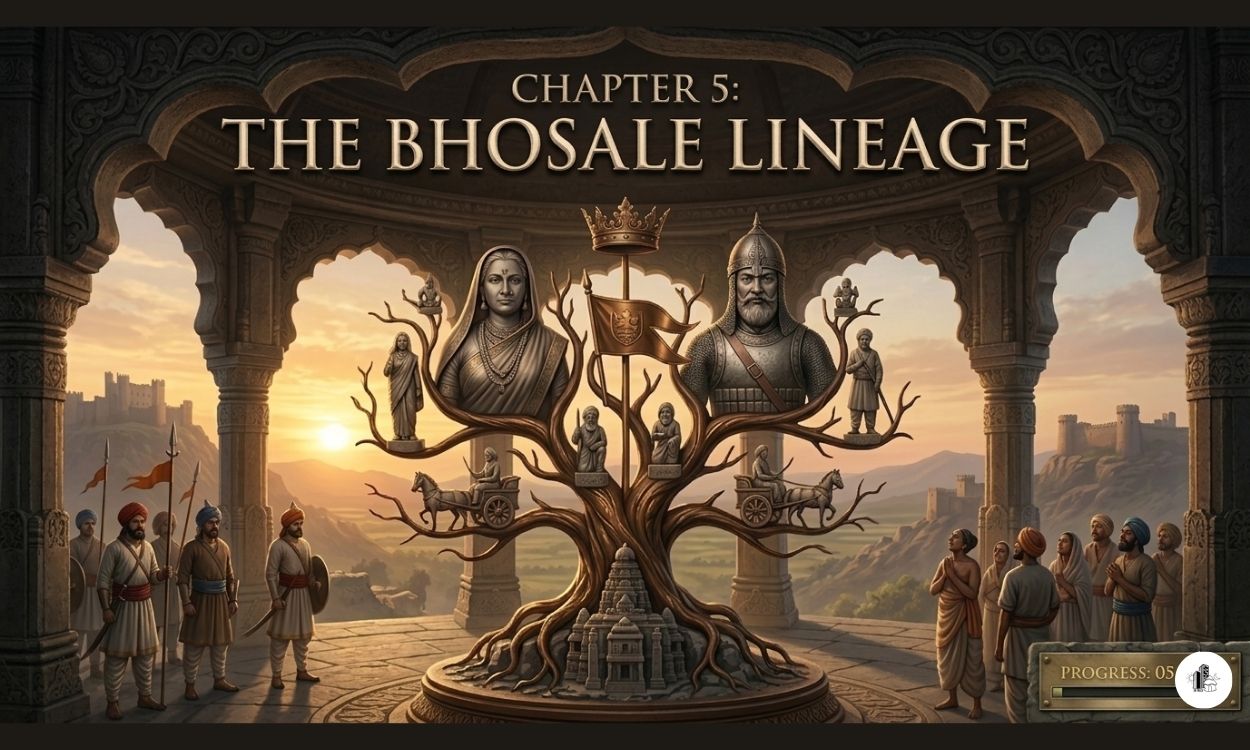
The Swarajya Chronicles: Book 1, Chapter 5
Current Focus: The Pre-Swarajya Landscape (1300–1630)
Progress: 05 / 100 Chapters Completed….
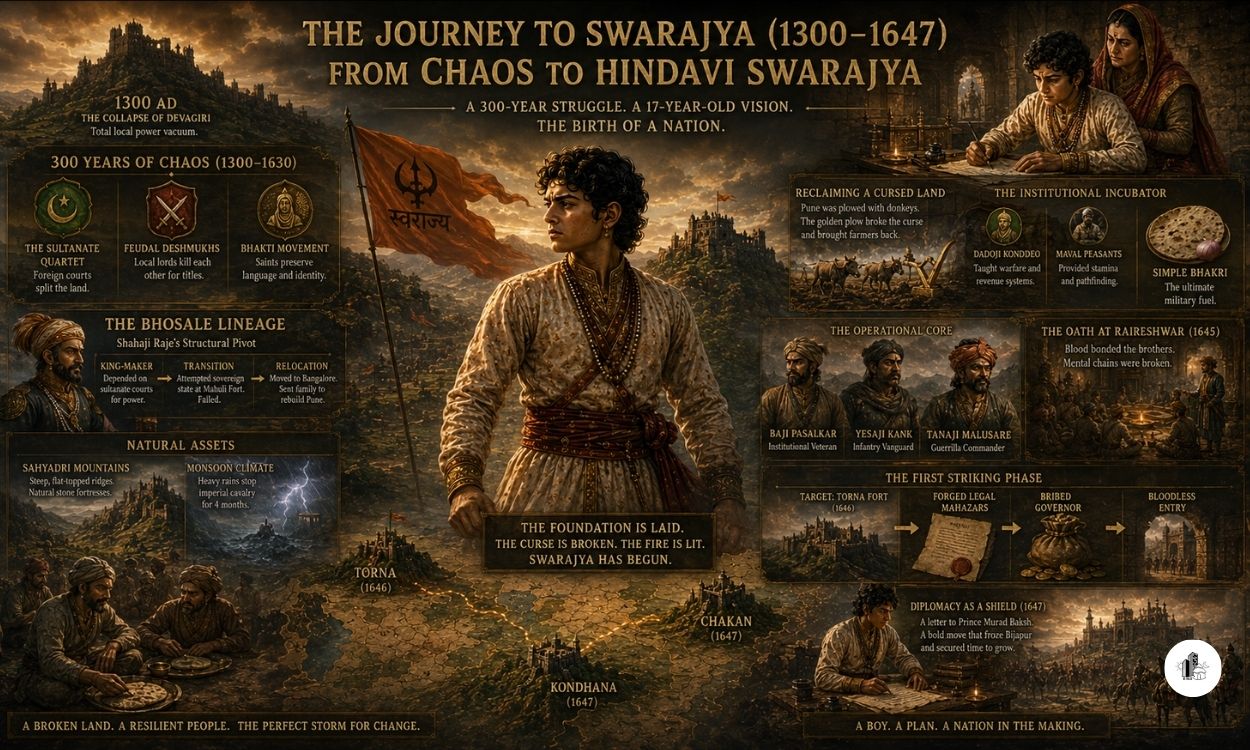
While the Deshmukhs managed the soil and the Bhakti saints tended to the soul, a new political force was quietly coalescing in the village of Verul. This was the rise of the Bhosale clan, a family that would eventually synthesize the rugged martial tradition of the Deccan with the profound spiritual yearning for Swarajya. If the Deshmukhs provided the structure and the Saints provided the spirit, the Bhosales provided the steel.
The story of the Bhosales is not merely one of genealogical progression; it is a story of social mobility. In a time when the feudal hierarchy was often rigid, the Bhosales demonstrated that merit, military entrepreneurship, and strategic vision could elevate a family from village headmen to the masters of empires.
The Roots at Verul: The Legend of Babaji Bhosale
Our narrative begins in the long, evening shadows cast by the magnificent Ellora caves. The village of Verul, nestled in the heart of the Deccan, was the ancestral seat of the Bhosales. Here, they held the position of Patils—the village headmen responsible for local administration and tax collection.
The patriarch, Babaji Bhosale, was a man of the earth, deeply rooted in the agrarian cycles of the Deccan. However, his sons, Maloji and Vithoji, were men of the sword. They represented a “new nobility.” Unlike the ancient Deshmukh clans who had held their lands for centuries and grew stagnant in their local power, the Bhosales were migratory and ambitious.
They looked beyond the boundaries of their village. The Deccan was in a state of constant flux; the “Sultanate Quartet” was always in need of capable fighters. The Bhosales realized that the plow could feed a family, but the sword could build a legacy. They transitioned from being landlords to becoming Mansabdars—military commanders who traded their martial prowess for political influence and land grants.
Maloji Bhosale: The Visionary Rise
The ascent of Maloji Bhosale is one of the most romanticized chapters in Maratha history, often draped in the golden cloth of legend. Folklore tells of a divine vision and a hidden treasure discovered at the Grishneshwar Temple, which allowed Maloji to buy horses and arms to raise a private cavalry.
While the legends add a layer of destiny, the historical reality was fueled by sheer military merit. During the late 16th and early 17th centuries, the Nizam Shahi of Ahmadnagar was a kingdom under siege. It was being squeezed between the Adil Shahi of Bijapur to the south and the massive, encroaching shadow of the Mughal Empire from the north. The Sultanate was desperate for local generals who knew the terrain, spoke the language, and could command the loyalty of the Maratha peasantry.
Maloji filled this vacuum perfectly. But he was more than a mercenary. He understood the importance of Cultural Patronage. His famous renovation of the Grishneshwar Temple (one of the 12 Jyotirlingas) and the construction of a large water tank at Shambhu Mahadev (Shikhar Shingnapur) were strategic acts. They signaled to the Marathi-speaking population that the Bhosales were not just servants of a Persian-speaking Sultan; they were the custodians of the local faith. They were reclaiming the sacred landscape of the Deccan, one stone at a time.
“Wait, have you read this yet?“
Chapter 6: Shahaji Raje (Part I) – The Kingmaker of the Deccan
Chapter 4: The Deshmukhs – The Guardians and the Gangsters of the Deccan
The Marriage of Two Worlds: The Union of Shahaji and Jijabai
In the year 1605, a pivotal event occurred that would alter the course of Indian history: the marriage of Maloji’s son, Shahaji, to Jijabai, the daughter of Lakhuji Jadhavrao of Sindkhed.
On the surface, it was a matrimonial alliance between two noble families. Below the surface, it was a political earthquake. The Jadhavraos were “Old Guard” nobility—powerful Deshmukhs who claimed direct descent from the Yadavs of Devagiri (the fallen empire we explored in Chapter 1). They represented ancient royal legitimacy and immense wealth.
The Bhosales, by contrast, were the “Rising Stars”—the new military elite. By uniting these two houses, the marriage fused the prestige of the past with the martial energy of the present. This union created a lineage that carried the DNA of ancient royalty and the adaptive, guerrilla-fighting spirit of the new Maratha class. In the person of Jijabai, the virtues of the Yadavs and the Bhosales would eventually find their ultimate expression.
Navigating the Sultanate Quartet
By the early 1600s, the Bhosales had become indispensable to the Deccan’s survival. They were the backbone of the Nizam Shahi’s defense against Mughal expansion. However, this period was also a “Great Game” of immense complexity and personal tragedy.
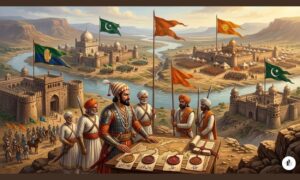
The Service: The Bhosales led thousands of Bargirs (cavalrymen) and Shiledars (independent horsemen). Their expertise in Ganimi Kava (guerrilla warfare) made them a nightmare for the slow-moving Mughal armies.
The Conflict: The tragedy of this era was that Marathas were often pitted against Marathas. Because different clans served different Sultans, it was not uncommon to see the Bhosales on one side of a battlefield and their own kinsmen, like the Jadhavraos, on the other.
The Realization: Through this constant warfare, a critical truth began to dawn on the Bhosales. They realized that the Sultanates of Ahmadnagar, Bijapur, and Golkonda survived almost entirely on Maratha muscle and Maratha blood. Yet, despite their sacrifices, the Marathas remained subordinates—servants to crowns that viewed them as mere tools. The seed of a sovereign identity—the idea that the Marathas should be masters of their own land—began to germinate in the courts and camps of the Bhosale clan.
Transitioning to Shahaji Raje: The Kingmaker
As Chapter 5 draws to a close, the focus shifts to the towering figure of Shahaji Raje Bhosale. By the 1620s, Shahaji was no longer just a village Patil or a standard commander; he was a Kingmaker.
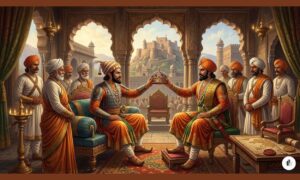
His career was a masterclass in Deccan Diplomacy. He served the Nizam Shahi with distinction, briefly joined the Mughals when the Sultanate’s internal politics turned toxic, and eventually moved to the service of the Adil Shahi of Bijapur. Through these shifts, Shahaji wasn’t being disloyal; he was being strategic. He was consolidating power, acquiring vast Jagirs (fiefdoms) in Pune and Bangalore, and ensuring that his family remained the most influential players in the region.
Shahaji Raje was the ultimate bridge. He stood with one foot in the old world of feudal service to the Sultans and the other foot in a future that had not yet been named. He was the nurseryman of a dream, protecting the land and the people until the time was right for the next generation to take the final, revolutionary step.
Loving this analysis? Let’s stay connected!
Join our WhatsApp & Telegram Channels: Get the latest movie alerts and box office updates directly on your phone. [WhatsApp] & [Telegram]
Follow us on X (Twitter): For quick threads, daily polls, and viral cinema news. [Click Here]
Join our Quora Space: Participate in deep discussions and share your own theories with fellow movie buffs. [Click Here]
What do you think?
The rise of the Bhosales presents a fascinating historical paradox. On one hand, they were loyal servants of Islamic Sultanates for generations, often fighting against their own people. On the other hand, they used that very service to rebuild temples, protect local traditions, and acquire the military training necessary to eventually overthrow those same Sultanates.
Do you think the Bhosales’ long “apprenticeship” under the Sultans was a necessary evil? Could Swarajya have ever succeeded if the Bhosales hadn’t first learned the secrets of administration, siege warfare, and high-level diplomacy from the inside of the Sultanate courts? Or did this long period of service delay the inevitable independence of the Deccan?








Leave a Reply