

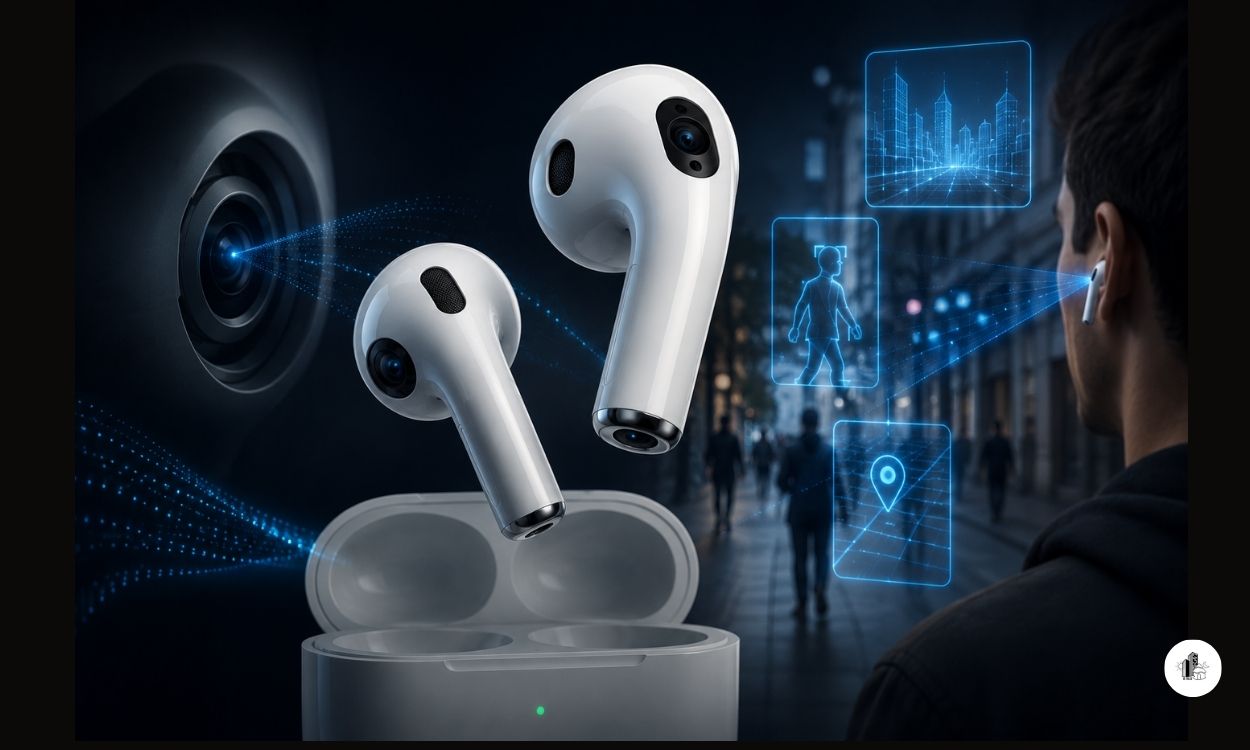
Imagine walking through a busy street in a foreign city. You feel a light tap on your shoulder, but no one is there. Instead, a calm voice in your ear whispers, “The cafe you like is ten feet to your right.” You aren’t looking at your phone. You aren’t even wearing smart glasses. This magic comes from your earbuds. Recent reports suggest Apple is working on AirPods with built-in cameras. This sounds like science fiction, right? However, it is quickly becoming our new reality. This move could turn a simple music device into a powerful AI assistant. Let’s dive deep into how this works and why it matters for you.
Why Would AirPods Need Cameras?
Most people use AirPods for music or phone calls. Adding a camera seems strange at first. You might wonder where the lens would even fit. However, the goal is not taking selfies. These cameras will act as “eyes” for Artificial Intelligence. They will look at the world from your perspective. Apple wants your devices to understand your surroundings.
By seeing what you see, the AI provides better help. For example, it could identify a grocery item. It might even translate a sign in real-time. This is called “spatial intelligence.” It bridges the gap between digital data and the physical world. Your earbuds will finally know where you are.
“Wait, have you read this yet?“
How the Technology Actually Works
Building a camera into an earbud is a massive challenge. Space is very limited inside the plastic casing. Apple will likely use tiny infrared sensors. These are similar to the FaceID tech on your iPhone. These sensors do not “see” color like a normal camera. Instead, they map out shapes and distances.
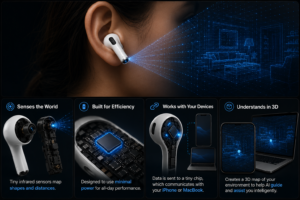
These sensors consume very little battery power. They send data to a tiny chip inside the AirPods. That chip talks to your iPhone or MacBook. Together, they create a 3D map of your environment. This helps the AI understand the layout of a room. It can then guide you through a crowded airport easily.
A New Life for the Visually Impaired
This technology is a game-changer for accessibility. People with vision loss often struggle in new places. Traditional canes only feel what is on the ground. A camera-equipped AirPod can “see” eye-level obstacles. It can warn the user about a low-hanging branch.
The AI can also read text out loud. Imagine standing in front of a restaurant menu. The AirPods could read the daily specials to you. This provides a level of independence never seen before. It turns a fashion accessory into a vital medical tool. This is where Apple truly shines with its innovation.
Solving the “Cocktail Party” Problem
Have you ever been in a loud party? It is hard to hear the person right in front of you. Engineers call this the “Cocktail Party Problem.” Normal hearing aids struggle to pick the right voice. Camera AirPods could solve this using “visual intent.”
The camera detects who you are looking at. It tracks the movement of their lips. Then, the AI boosts the audio from that specific direction. At the same time, it cancels out the background noise. This creates a “superpower” for your hearing. You will never miss a word in a loud room again.
Privacy: Who is Watching?
We must talk about the elephant in the room. A camera on your ear raises big privacy questions. People around you might feel uncomfortable. They may worry about being recorded without knowing. Apple is known for focusing on user privacy.
They will likely use “Local Processing” for this data. This means the images never leave your device. They are not stored in a cloud or sold to advertisers. The camera might only “see” outlines rather than clear faces. Still, society will need time to accept this change. Clear indicator lights might be added to show when the camera is active.
The Death of the Smartphone?
Some experts believe we are reaching “peak smartphone.” We are tired of staring at screens all day. It hurts our necks and ruins our focus. Wearables like AirPods and smart glasses offer a hands-free future. If your earbuds can see, your phone can stay in your pocket.
You could ask, “Where did I leave my keys?” The AI, having seen them earlier, would answer. This makes technology feel more natural. It moves from a screen into the air around us. We are moving toward a world of “Ambient Computing.” Here, the computer is always there but never in the way.
Battery Life and Thermal Challenges
Processing video data takes a lot of energy. AirPods already have very small batteries. Adding a camera could drain them in minutes. Apple needs to find a way to keep them cool. Cameras generate heat, which is uncomfortable inside an ear canal.
We might see a new “H-series” chip designed for this. This chip would handle AI tasks with extreme efficiency. Apple might also use a larger charging case. This case could act as a secondary brain for the earbuds. Solving these hardware issues is the next big hurdle.
Loving this analysis? Let’s stay connected!
Join our WhatsApp & Telegram Channels: Get the latest movie alerts and box office updates directly on your phone. [WhatsApp] & [Telegram]
Follow us on X (Twitter): For quick threads, daily polls, and viral cinema news. [Click Here]
Join our Quora Space: Participate in deep discussions and share your own theories with fellow movie buffs. [Click Here]
When Can We Buy Them?
Production usually takes years after the first reports surface. We might see these AirPods by late 2026 or 2027. Apple usually tests many prototypes before a launch. They want to ensure the user experience is perfect.
It will likely start as an “AirPods Pro” or “Max” feature. These higher-end models have the space for extra hardware. Once the tech gets cheaper, it will move to base models. For now, we can only watch the patent filings closely.
Final Thoughts on a Visible Future
The idea of cameras in our ears is bold. It pushes the boundaries of what a gadget can be, is about more than just music or fashion, is about giving AI a body in the physical world. While there are hurdles, the potential benefits are huge. From helping the blind to making us more productive, the future looks bright. Apple is clearly betting that the next big thing isn’t a screen. It is a pair of ears that can finally see.









Leave a Reply