

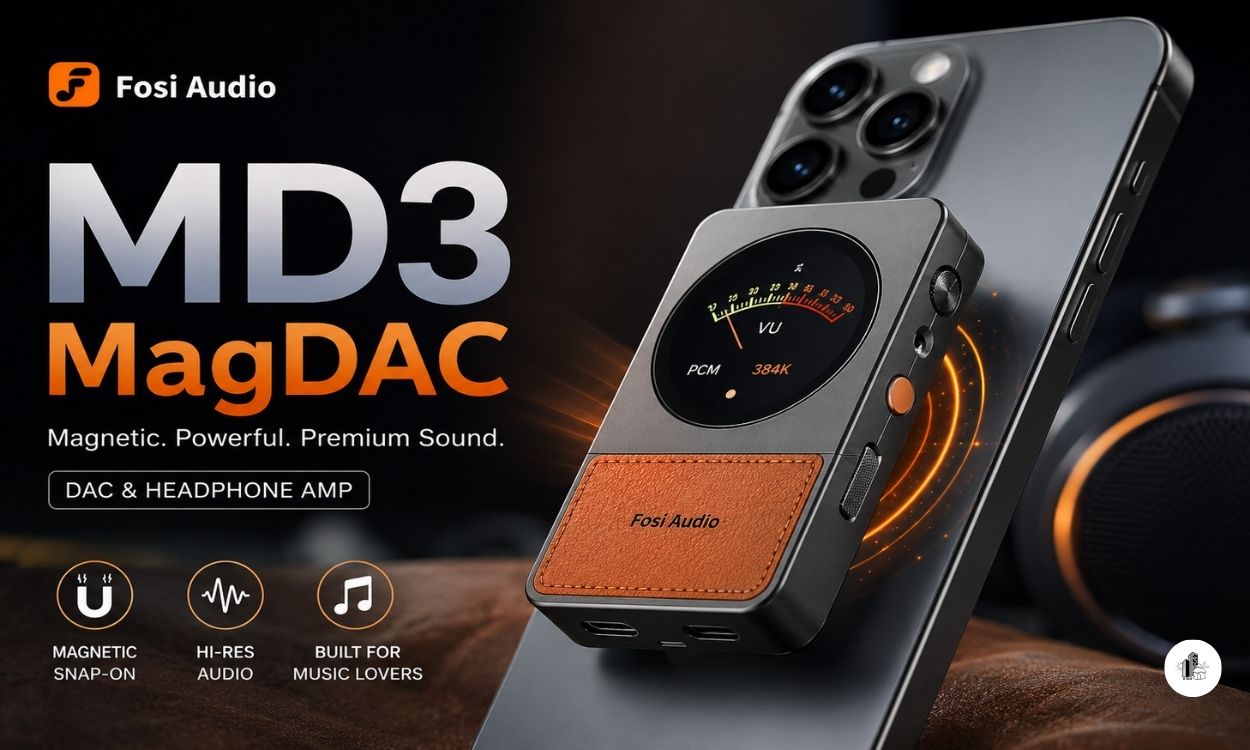
Millions of music lovers have surrendered their ears to low-quality wireless earbuds. Most smartphones no longer have headphone jacks, forcing us into a world of compressed audio. To fix this, tech companies created portable headphone decoders, called dongle DACs. However, these traditional gadgets usually dangle awkwardly from your phone charging port like a piece of plastic medical equipment. The new Fosi Audio MD3 MagDAC aims to destroy that ugly design completely.
Launched globally in May 2026, the Fosi Audio MD3 is a portable DAC and headphone amplifier that sticks directly to the back of your smartphone using strong magnets. It does not just sit there looking boring. Fosi Audio MD3features an interactive, circular screen, a hand-stitched leather back panel, and high-end audio chips usually saved for expensive home audio gear. It is a complete reimagining of what mobile high-fidelity audio can look and feel like.
Getting Rid of the Cable Chaos with Neodymium Magnets
The biggest problem with portable headphone amplifiers is how they travel in your pocket. Traditional setups use a short cable that leaves the amplifier dangling, putting stress on your phone port. Fosi Audio solves this issue by borrowing a popular smartphone trend.
The Reassuring Snap of 16 Magnets
The backplate of the MD3 houses sixteen high-strength N52 Neodymium magnets. These magnets allow the device to snap firmly onto any MagSafe-compatible iPhone or Android case.
The Backpack Design: The unit clings to the back of your phone like a small, tight backpack, creating a single, solid block.
No Magnetic Buzz: Audio purists often worry that magnets will ruin the sound signal. Fosi Audio placed an aluminum alloy isolation plate between the magnets and the circuit board to block all electrical noise.
Premium Touch: The magnetic side features a bright orange, hand-stitched leather finish. This gives your fingers a soft, warm place to grip when holding your phone.
“Wait, have you read this yet?”
Heavyweight Audio Specs Inside a Fifty-Gram Body
Despite weighing just 50 grams, the internal components of the MD3 match up with large desktop audio setups. Fosi Audio did not cut any corners on the internal decoding chips.
The Flagship Sabre Engine
At the heart of the device is the ESS Sabre ES9039Q2M DAC chip. This chip converts digital files from your streaming apps into clean, analog sound waves for your ears. It supports high-resolution files up to 32-bit/384kHz PCM and native DSD256. This means your highest-quality FLAC audio files will play with absolute clarity, revealing tiny details in your music that wireless earbuds erase completely.
Dual USB-C Ports and the Power Problem
The biggest complaint about external smartphone amplifiers is battery drain. High-resolution audio chips need a lot of power, and they usually eat up your phone’s battery within a few hours.
True Pass-Through Power Integration
The MD3 introduces a brilliant solution by placing dual USB-C ports on its CNC-machined aluminum body. One port sits on the top edge, and the second port sits on the bottom.
This dual-port design allows for pass-through charging. You can plug a power bank or wall charger into the top port. The MD3 uses that external power to run its internal amplifiers while simultaneously routing juice through the bottom port to charge your phone. This completely removes battery anxiety during long train commutes or work sessions.
Audio Performance: Balanced vs Single-Ended
The MD3 offers two separate audio outputs on its bottom panel to accommodate different headphone cables. The power delivery varies significantly depending on which port you choose.
Output Power and Specifications
| Audio Output Port | Maximum Power Output | Best Real-World Use Case |
| 3.5mm Single-Ended | ≥80mW x2 @ 32Ω | Standard earphones, daily earbuds, and sensitive casual headphones. |
| 4.4mm Pentaconn Balanced | ≥180mW x2 @ 32Ω | High-end In-Ear Monitors (IEMs) and entry-level planar headphones. |
The sound profile of the MD3 is tuned to be neutral, clean, and uncolored. It does not boost the bass artificially or make the vocals pierce your ears. Instead, it offers a wider soundstage and an ultra-low noise floor. This means when your music falls silent, you will hear absolute, beautiful black silence without any annoying background hiss or static buzz.
Loving this analysis? Let’s stay connected!
Join our WhatsApp & Telegram Channels: Get the latest movie alerts and box office updates directly on your phone. [WhatsApp] & [Telegram]
Follow us on X (Twitter): For quick threads, daily polls, and viral cinema news. [Click Here]
Join our Quora Space: Participate in deep discussions and share your own theories with fellow movie buffs. [Click Here]
A Circular Display with Personality and Retro Charm
Most audio dongles have no screen at all, or perhaps a single tiny light that changes color. The MD3 changes this by placing a 1.28-inch circular LCD screen right on its front face.
Beyond Basic Volume Meters
This display is highly interactive. The default mode shows a classic, moving retro VU meter that dances along with the beat of your music. You can also change the screen to show a spinning vinyl record animation or a rotating tape reel.
Using the physical side button, called the Vista Button, you can customize the screen even further. You can upload your own custom family photos, wallpaper images, or emojis through your computer. Fosi Audio even packed three interactive mini-games into the software: Rolling Dice, a Wine Bottle spinner, and Rock-Paper-Scissors. It turns a serious piece of audio gear into a fun, tactile desktop companion.
Understanding the Physical Limits
While the MD3 is a massive upgrade over regular phone sound, it cannot bend the laws of physics. With a maximum output of 180mW on the balanced port, it is tailor-made for In-Ear Monitors (IEMs) and standard, portable headphones.
If you try to plug in giant, hard-to-drive studio headphones that require several watts of power, the sound will thin out, and the bass will lose its punch. It is an incredible pocket companion, but it is not a replacement for a massive, desktop-powered amplifier stack.
What Do You Think?
Does the idea of snapping a magnetic, leather-backed audio amplifier to your phone sound like the perfect cure for messy headphone cables? Or do you prefer sticking with wireless convenience, even if it means sacrificing sound quality?


















Leave a Reply