

The Swarajya Chronicles: Book 1, Chapter 9
Current Focus: The Pre-Swarajya Landscape (1300–1630)
Progress: 09 / 100 Chapters Completed….
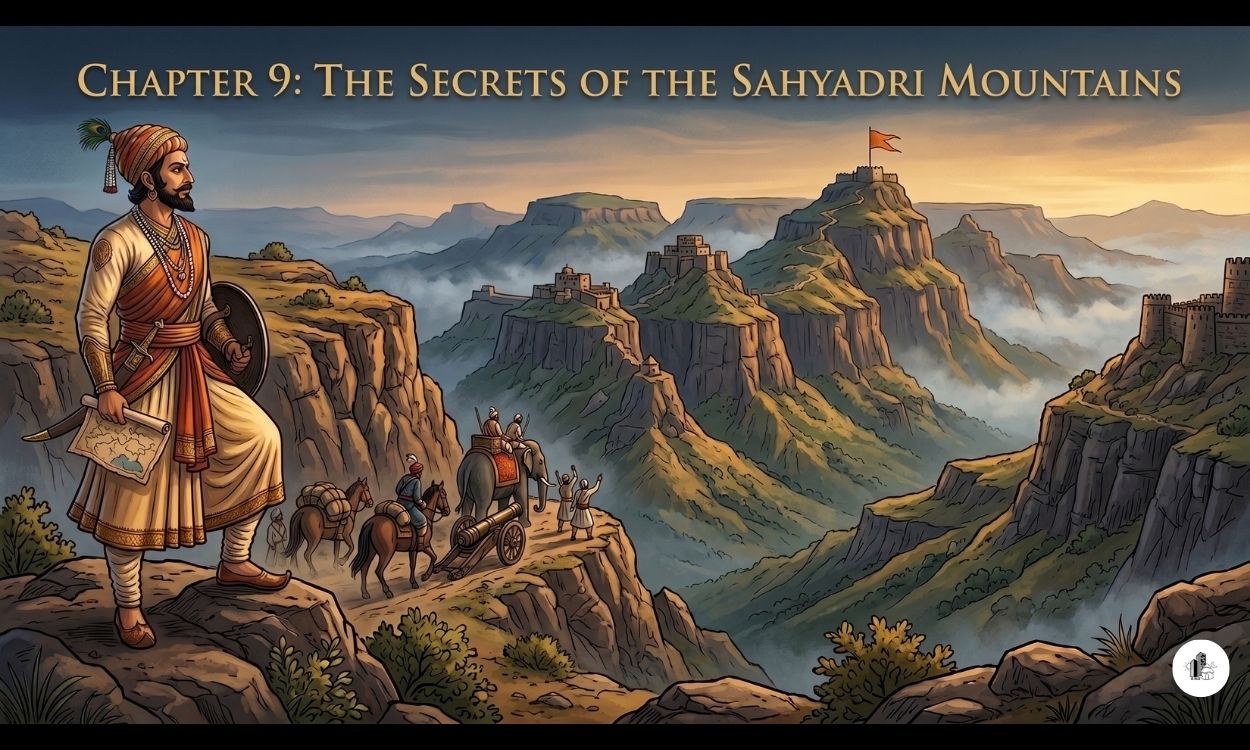
Imagine you are a general leading a massive army. You have thousands of soldiers and heavy cannons. You feel invincible. Suddenly, you reach a place where the road disappears. The mountains rise like giant walls of black stone. The paths are so narrow that only one horse can pass at a time. This was the nightmare for the Mughal and Sultanate armies. They were fighting more than just the Marathas. They were fighting the Sahyadri Range.
In this chapter, we explore how Shivaji Maharaj turned these mountains into a weapon. He did not just live in the hills, he mastered them, used every cliff, every valley, and every rain cloud as a tool of war. For him, the land was a living ally. It was the “Great Wall” of the Swarajya blueprint.
The Natural Fortress of the Deccan
The Sahyadri Range, or the Western Ghats, is the spine of Maharashtra. These mountains are made of hard volcanic rock. They have flat tops but very steep sides. To a layman, they look beautiful. To a soldier, they look impossible.
Shivaji Maharaj realized this early in his life. He saw that big empires liked fighting on flat plains. On a plain, the army with more soldiers usually wins. But in the Sahyadri, numbers do not count for much. A few men at the top can stop thousands at the bottom. This was the start of a massive geopolitical shift. The power was moving from the plains to the peaks.
How Topography Became a Force Multiplier
In military terms, a “force multiplier” is something that makes a small group look big. The Sahyadri was the ultimate force multiplier. The mountains are full of “V-shaped” valleys and “U-shaped” ridges.
Most foreign armies relied on heavy cavalry. Their horses were fast on flat land. However, these horses could not climb the slippery basalt rock of the Sahyadris. The heavy cannons of the Mughals were also useless here. You cannot drag a three-ton cannon up a hidden mountain track. Shivaji Maharaj knew this weakness. He lured his enemies into deep jungles where their size became their biggest problem. He used the land to shrink the enemy’s strength.
“Wait, have you read this yet?“
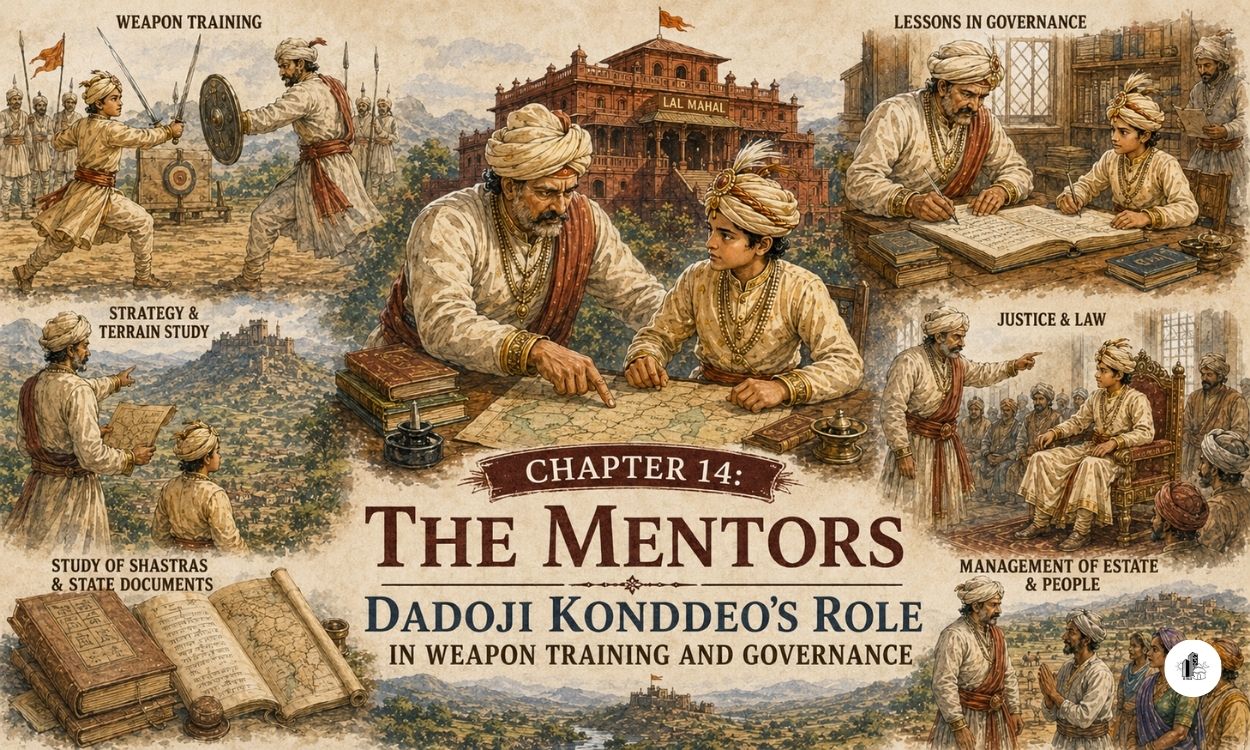
Chapter 8: Jijau Maa- The Daughter of Sindkhed Raja & Mother of Swarajya
The Engineering of the Sahyadri Forts
The Maratha forts were not just buildings. They were extensions of the mountain itself. Shivaji Maharaj and his engineers looked for “natural towers.” These were volcanic plugs that rose straight up.
If a mountain side was a bit easy to climb, they used a trick called “scarping.” They would literally cut the rock to make it vertical. This made the fort wall a natural part of the mountain. Even if an enemy broke the gate, they could not climb the sides. These forts had amazing water systems too. They carved tanks directly into the rock. This allowed the Mavala warriors to stay inside for years. They never ran out of water, even during long sieges.
The Mavala: Warriors Born of the Soil
Geography also creates the people who live on it. The people of the Maval region were the backbone of the movement. These men were not tall or heavy like the Northern soldiers. Instead, they were lean, fast, and very tough.
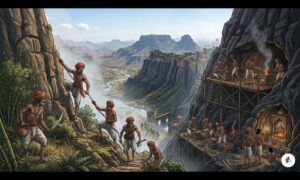
They grew up climbing these cliffs every day. They knew every “hidden goat-path” in the Sahyadri. While the enemy followed the main roads, the Mavalas moved through the thick bush. They could strike the enemy from behind and vanish into the mist. This was the soul of Ganimi Kava, or guerrilla warfare. The mountains gave them the cover they needed. Without the Sahyadri, the Mavala tactics would not have worked.
The Monsoon: Nature’s Defensive Shield
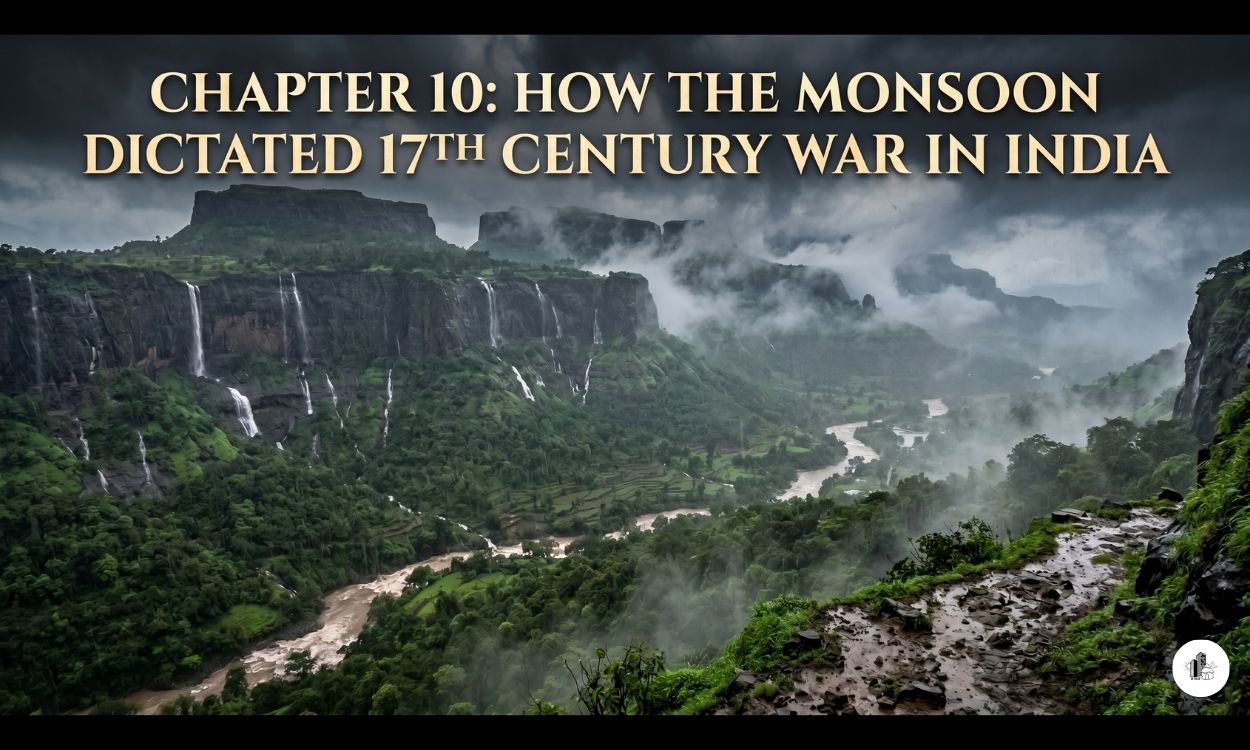
The weather in the Sahyadri is just as aggressive as the mountains. During the monsoon, the range receives massive rainfall. The paths become muddy and very slippery. The rivers turn into rushing torrents.
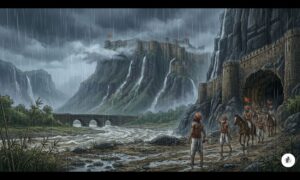
Shivaji Maharaj used this season perfectly. Foreign armies were used to dry, flat weather. In the Sahyadri rain, their gunpowder became damp. Their soldiers got sick with tropical fevers. The Marathas, however, were at home. They used the fog to hide their movements. Nature served as a biological weapon against the invaders. It was a shield that no empire could break with gold or steel.
Analysis: The Strategic Mastery of Terrain
Why does the geography of the Sahyadri matter so much in history? It provided the asymmetric advantage needed for Swarajya to survive.
Logistical Paralysis: The mountains forced the enemy to leave their heavy supply wagons behind. This made the massive Mughal army hungry and weak very quickly.
Tactical Chokepoints: Narrow passes like the Bhor Ghat acted as filters. They only let a few enemy soldiers through at a time. The Marathas could then pick them off easily.
Psychological Dominance: The heights of the Sahyadri gave the Marathas a “bird’s eye view.” They always knew where the enemy was. The enemy, meanwhile, was always looking up in fear.
Economic Fortress: The mountains protected the farming villages in the valleys. This ensured that the Swarajya economy kept running even during big wars.
This wasn’t just luck. It was a brilliant use of topography as a weapon. Shivaji Maharaj did not fight against the environment. He invited the environment to join his army.
Loving this analysis? Let’s stay connected!
Join our WhatsApp & Telegram Channels: Get the latest movie alerts and box office updates directly on your phone. [WhatsApp] & [Telegram]
Follow us on X (Twitter): For quick threads, daily polls, and viral cinema news. [Click Here]
Join our Quora Space: Participate in deep discussions and share your own theories with fellow movie buffs. [Click Here]
The Silent Wall of History
Even today, when you visit a fort like Raigad or Rajgad, you feel the power of the land. The wind howls through the gaps. The cliffs look down on the world. You realize that these stones witnessed the birth of a nation.
The Sahyadri was the cradle of the Maratha spirit. It taught the people to be independent. It taught them that a small, determined group can defeat a giant. The mountains did not just provide a place to hide. They provided a way to win. The geography of Maharashtra was the most loyal soldier Shivaji Maharaj ever had.
What Do You Think?
Do you think Shivaji Maharaj could have built Swarajya if he was born in the flat plains of the North? Is geography still a weapon in modern times, or has technology made mountains useless? Does the “mountain spirit” still exist in the people of the Maval today?














Leave a Reply