

India’s New Labour Codes: A Fresh Start for Workers
Welcome to theustales.com.
Have you heard the buzz about India’s new labour laws? They kicked in on November 21, 2025, and sparked a lot of talk. Many workers worried their paychecks would shrink. But hold on – the government says that’s not the case. In fact, these changes aim to make things fairer and clearer for everyone. Let’s dive in and see what this means for you.
Understanding the Big Picture
The government rolled out four key labour codes. They replace 29 old laws. This simplifies things a lot. Now, we have the Code on Wages, the Industrial Relations Code, the Code on Social Security, and the Occupational Safety, Health and Working Conditions Code.
These codes took effect recently. The goal? To boost transparency and protect workers better. During the shift, old rules stay in place until new ones fully apply. Officials promise ongoing talks with people and groups to shape the details.
You may Also Like:
No Drop in Your Take-Home Pay
Workers feared lower salaries under the new setup. Why? The rules say basic pay must form at least 50% of total wages. Before, companies often split pay into many allowances. This kept basic pay low.
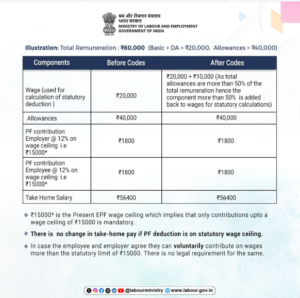
However, the labour ministry cleared the air. They posted on X about it. Take-home pay stays the same for most. The reason lies in provident fund rules. PF deductions stick to the ₹15,000 monthly cap. Only if you and your boss agree to more, it changes.
So, even if basic pay rises, PF won’t jump automatically. This brings relief to many. The ministry stressed uniformity, not cuts. Employees should not panic over instant changes.
A Simple Example
Let’s look at numbers. Suppose you earn ₹60,000 monthly. Basic pay plus dearness allowance is ₹20,000. Allowances make up ₹40,000.
Under old and new rules, PF calculates on ₹15,000. Employer contributes ₹1,800. You add ₹1,800 too. Your take-home? Still ₹56,400. No difference.
If allowances top 50%, they shift to wages. But PF cap holds firm. Only voluntary hikes affect pay.
Benefits for All Kinds of Workers
These codes cover everyone. Gig workers get new definitions. Aggregators must chip in 1-2% of turnover for their funds. This caps at 5% of payments to workers.
Contract workers gain health perks and gratuity after a year. They also get free yearly check-ups.
Women see big wins. They can work nights with consent and safety. Equal pay rules ban discrimination. Parents-in-law count as family for benefits.
Youth get protection from exploitation. They earn minimum wages and paid leave.
MSME workers access basics like canteens and rest areas. They follow standard hours with double overtime pay.
Special Groups Get Attention
Beedi and cigar makers cap hours at 8-12 daily, 48 weekly. They earn bonuses after 30 days yearly.
Plantation staff join the codes if over 10 workers or 5 hectares. They receive safety training and protective gear. Families get ESI medical care and kids’ education.
Audio-visual pros, like journalists and artists, claim full benefits. Overtime needs consent and pays double.
Mine workers see accidents during commutes covered sometimes. Hours limit to 8-12 daily for balance.
Hazardous jobs mandate national standards. Women can join any role with safety committees.
Textile migrants earn equal wages and portable benefits. They claim dues up to three years.
IT folks get salaries by the seventh monthly. Women work nights safely. Disputes resolve quickly.
Dock workers gain recognition. They access PF, pension, and insurance, even if temporary.
Export sector fixed-term staff match permanent perks. They take leaves after 180 days.
Broader Reforms That Matter
A national floor wage sets a minimum living standard. No one falls below it.
Gender rules go neutral. They include transgender persons and ban bias.
Inspectors now guide more than punish. This helps compliance.
Disputes speed up with two-member tribunals. You go straight after talks.
One registration, license, and return simplify filings.
A national board sets safety standards across fields.
Factories with under certain limits face less red tape. But workers stay protected.
Pension talks continue. Some push for hikes, especially under ₹1,000. The government notes past minimums like ₹1,000 for widows.
In Kerala, MPs asked to raise PF cap to ₹30,000. The minister said it needs wide talks. It impacts hiring costs and pay.
Overall, these codes shift focus to worker rights. They build a balanced system.
The ministry repeated: Changes promote clarity. Not pay cuts. For higher PF, it’s your choice.
As we wrap up, remember the date. These started November 21, 2025. Stay informed.
FAQs
Will my take-home salary decrease right away?
No, it won’t. PF sticks to ₹15,000 cap unless you choose more.
What if my allowances exceed 50%?
They add to wages. But PF deductions remain capped. No automatic drop.
Do gig workers get new benefits?
Yes, aggregators contribute to funds. Benefits become portable via Aadhaar.
Can women work in any job now?
Absolutely, including nights and hazardous roles. With consent and safety.
How do the codes help contract workers?
They get health benefits, gratuity after a year, and free check-ups.
Is PF above ₹15,000 mandatory?
No, it’s voluntary. You and your employer decide together.