
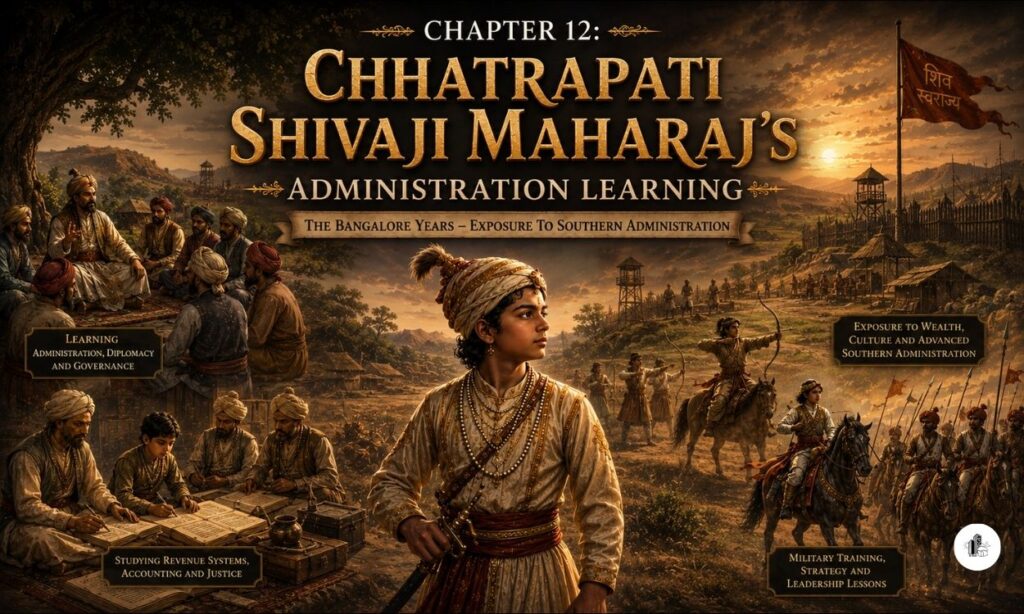
The Swarajya Chronicles: Book 2, Chapter 12
Current Focus: The Boy and the Vow (1630–1647)
Progress: 12 / 100 Chapters Completed….
When we think of Chhatrapati Shivaji Maharaj, our minds instantly fly to the rugged hills of Maharashtra. We picture the black stone of the Sahyadris, the hidden jungle tracks, and the fierce battle cries of the Mavalas. However, a crucial part of the Swarajya blueprint was actually designed far away from the Deccan hills. To truly understand how a young boy learned to manage an empire, we must travel south. We must look at the grand, wealthy, and sophisticated city of Bangalore during the late 1630s and early 1640s.
Following the turbulent events of his birth and early childhood, a major geopolitical shift took place in the life of the young prince. His father, Shahaji Raje Bhosale, had become a premier military commander for the Bijapur Sultanate. As a reward for his massive southern conquests, the Sultan granted him the prosperous jagir of Bangalore. It was here, in this flourishing cultural and political hub, that the young Shivaji Maharaj spent his highly formative years. This chapter explores how his time in the South served as his ultimate political university.
The Grand Court of Shahaji Raje
In the 17th century, Bangalore was not just a military outpost. Under the governance of Shahaji Raje, it became a magnificent shadow court that rivaled the grandest sultanates. Shahaji Raje lived like a sovereign king in his palace, surrounded by wise scholars, brave captains, and brilliant administrators.
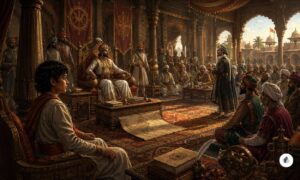
For the young Shivaji Maharaj, walking into his father’s court was an eye-opening experience. He was no longer just a fugitive hiding in mountain safehouses. Instead, he was now the son of one of the most powerful diplomats in India. He sat quietly by his father’s side, watching how grand assemblies were conducted. He observed how foreign ambassadors bowed, how treaties were debated, and how complex political marriages were arranged to secure alliances. This daily exposure stripped away any local limitations from his mind. He began to think like a continental statesman before he even reached his teenage years.
“Wait, have you read this yet?”
Learning the Secrets of Wealth and Revenue
A kingdom cannot run on swords alone; it runs on a steady stream of revenue. The southern territories under the Adilshahi were incredibly wealthy, boasting organized systems of taxation, thriving trade guilds, and bustling markets.

During his stay in Bangalore, Chhatrapati Shivaji Maharaj was introduced to the highly organized revenue systems originally perfected by southern kingdoms like Vijayanagara. He watched how land was surveyed, how taxes were gathered fairly without destroying the farmers, and how accounting books were maintained with absolute precision. He learned that a treasury must always be full if a ruler wants to maintain a standing army. When he later returned to Maharashtra to build Hindavi Swarajya, he did not have to invent a new system from scratch. He simply applied the brilliant financial lessons he had absorbed in the South.
The Military Renaissance of the South
Shahaji Raje did not just teach his son how to hold a pen; he ensured he knew how to wield the ultimate sword. The military landscape of the South was deeply advanced, featuring diverse forces, elephant corps, and state-of-the-art weaponry.
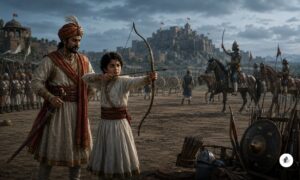
In Bangalore, the young prince underwent intense physical and military training. He mastered horse riding, archery, and the use of the traditional straight sword, the Dhop. More importantly, he watched his father manage a multi-ethnic army made up of Marathas, Muslims, and southern warriors. He learned the critical art of logistical planning – how to feed thousands of men on the march, how to set up secure camps, and how to maintain high discipline. He realized that a successful army relies 20% on raw bravery and 80% on flawless organization.
The Influence of Southern Art and Culture
An empire needs a soul, and the soul of Swarajya was deeply tied to its cultural and spiritual identity. Bangalore at the time was a haven for poets, saints, and scholars who had fled the destruction in the North.
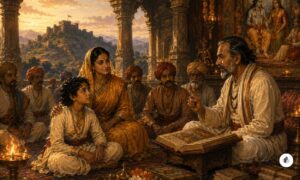
Under the loving guidance of Maa Jijau, who resided there with him, Chhatrapati Shivaji Maharaj was immersed in traditional learning. He listened to the grand stories of the Mahabharata and Ramayana recited by top scholars. He learned about the great kings of the past who had ruled with absolute justice. This environment instilled a deep sense of cultural pride in his young heart. He realized that the foreign sultanates were structurally vulnerable because they did not respect the local culture of the people they ruled. He vowed that his future state would be entirely different.
Technical Analysis: The Administrative Foundation
When we analyze his time in the South from a technical perspective, we can see exactly how Bangalore shaped his future administrative style.
-
De-centralized Governance Models: He observed how Shahaji Raje ruled distant territories through trusted local chieftains (Nayakas), a method he later perfected using his own loyal Deshmukhs.
-
Intelligence Network Design: The southern courts relied heavily on a sophisticated web of spies (Jasoods) disguised as traders and holy men. This inspired his later creation of the legendary Maratha intelligence wing.
-
Judicial Fairness System: He watched his father settle complex land disputes openly in the royal court, teaching him that immediate, corruption-free justice wins the complete loyalty of the common man.
-
Economic Diversification: Seeing how Bangalore thrived by protecting trade routes taught him to later build secure market towns like Peths around his own forts.
Loving this analysis? Let’s stay connected!
Join our WhatsApp & Telegram Channels: Get the latest movie alerts and box office updates directly on your phone. [WhatsApp] & [Telegram]
Follow us on X (Twitter): For quick threads, daily polls, and viral cinema news. [Click Here]
Join our Quora Space: Participate in deep discussions and share your own theories with fellow movie buffs. [Click Here]
The Return Journey: The Seeds of Rebellious Hope
By the early 1640s, the education of the young prince was complete. He was no longer just an energetic boy; he was a highly polished administrator, a trained warrior, and a deep thinker. He had seen the wealth of the South, but he had also seen that it was held together by foreign chains.
When Shahaji Raje decided it was time for Chhatrapati Shivaji Maharaj and Maa Jijau to return to their ancestral lands in Pune, he did not send them back empty-handed. He sent along a handpicked team of brilliant officers, including Dadoji Konddeo, Shamrao Nilkanth Rozekar, and Balkrishna Dikshit. These men carried the institutional knowledge of the southern administration straight into the ruined valleys of Maharashtra. The spark lit in Bangalore was now traveling back home to set the Deccan on fire.
What Do You Think?
Do you think Chhatrapati Shivaji Maharaj could have successfully built an empire if he had stayed only in the small valleys of Pune without seeing the grand administration of Bangalore? How important is it for a young leader to step away from their home turf to learn how the wider world works?