


The Swarajya Chronicles: Book 1, Chapter 7
Current Focus: The Pre-Swarajya Landscape (1300–1630)
Progress: 07 / 100 Chapters Completed….
Imagine standing on a mountain peak while two massive empires close in from all sides. The wind is cold, and the sound of war drums echoes from the valley below. This was the reality for Shahaji Raje Bhosale in 1636. He was a man who refused to let a dream die, even when the odds were impossible. After years of fighting to keep the Nizamshahi kingdom alive, he found himself cornered at the Mahuli Fort.
This chapter of his life is not just about battles; it is about a father’s survival and a leader’s tough choices. It is the story of how a fierce warrior from the rugged Sahyadri mountains ended up building a new home in the distant city of Bangalore.
The Siege of Mahuli: A Test of Iron Will
By 1636, the political landscape of the Deccan had turned into a nightmare for Shahaji Raje. The mighty Mughals from the North and the Adilshahi from the South had signed a peace treaty. Their main goal was simple: destroy Shahaji Raje and end the Nizamshahi dynasty for good. Shahaji Raje had taken refuge at the Mahuli Fort, located near modern-day Thane. He wasn’t alone; he had the young Nizam prince, his wife Rajmata Jijabai, and his son Shivaji Maharaj with him.

The Mughal general, Khan Zaman, surrounded the fort with a massive army. They cut off all supplies, hoping to starve the defenders into surrendering. Shahaji tried everything to break the siege. He even reached out to the Portuguese for help, but they were too afraid of the Mughals to step in. As the days passed, the situation inside the fort became desperate.
“Wait, have you read this yet?“
Chapter 6: Shahaji Raje (Part I) – The Kingmaker of the Deccan
A Heartbreaking Surrender
Shahaji Raje was a man of immense pride, but he was also a practical leader. He realized that if he continued to fight, everyone inside the fort – including his family – would perish. In October 1636, he made the most difficult decision of his career. He agreed to surrender Mahuli and the young Nizam prince to the Mughals.
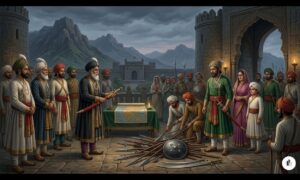
The fall of Mahuli marked the official end of the Nizamshahi kingdom. For Shahaji, it felt like his life’s work had been wiped away in a single moment. However, his enemies knew he was too talented to be killed. The Mughals gave him a choice: join the Adilshahi service, but on one condition – he must leave his beloved Maharashtra forever. They feared that if he stayed in the Sahyadri mountains, he would eventually rise again.
Exile or New Beginning? The Move to Bangalore
After the surrender, Shahaji Raje entered the service of the Adilshahi Sultanate of Bijapur. The Sultan sent him far away to the southern regions, specifically to the Karnataka territory. In 1638, after successful military campaigns against local chiefs, the Sultan granted him the Jagir (estate) of Bangalore.
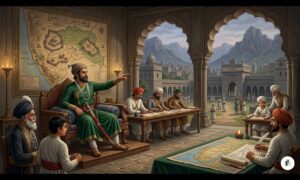
This move was a massive shift for the Bhosale family. While Shahaji Raje stayed in Bangalore with his second wife Tukabai, he sent Rajmata Jijabai and young Shivaji Maharaj back to their family estate in Pune. This separation was painful, but it was a clever move. It allowed Shahaji Raje to rebuild his power in the South while his son grew up in the heart of the Maratha lands.
The Strategic Shift – Why Bangalore Mattered
At first glance, moving to Bangalore looks like a defeat. However, if we look closer, this was a brilliant strategic pivot. By accepting the southern post, Shahaji removed himself from the direct eyes of the Mughal Emperor. This gave him the freedom to build a mini-kingdom in the South under the guise of an Adilshahi officer.

Furthermore, his presence in Bangalore created a “double-front” for his enemies. While he handled the South, he provided the financial and political cover for Shivaji Maharaj to begin the work of Swarajya in the North. Bangalore became a school for administration and diplomacy. It was here that many future Maratha leaders were trained under Shahaji’s watchful eye.
Building a Maratha Legacy in the South
Bangalore was not just a place of exile for Shahaji; he turned it into a grand center of culture and administration. He rebuilt the city’s mud fort into a stronger stone structure and established a royal court that mirrored the traditions of Maharashtra. He became a powerful “Subhedar” or governor, ruling over a large part of the Karnataka region.

Interestingly, young Shivaji Maharaj spent a few years of his youth in Bangalore with his father. It was here that the future Chhatrapati learned about complex administration and southern politics. Shahaji Raje might have been physically away from the Sahyadris, but he never lost his warrior spirit. He continued to protect his people and patronize scholars, keeping the dream of self-rule alive in his heart.
Loving this analysis? Let’s stay connected!
Join our WhatsApp & Telegram Channels: Get the latest movie alerts and box office updates directly on your phone. [WhatsApp] & [Telegram]
Follow us on X (Twitter): For quick threads, daily polls, and viral cinema news. [Click Here]
Join our Quora Space: Participate in deep discussions and share your own theories with fellow movie buffs. [Click Here]
Conclusion: The Silent Guardian
Shahaji Raje’s journey from the heights of Mahuli to the palaces of Bangalore shows us the true meaning of resilience. He lost a kingdom but gained a legacy. By accepting a life in the South, he provided a protective shield for Shivaji’s early experiments with Swarajya in Pune.
He was the silent architect who worked in the background so his son could one day lead the foreground. His time in Bangalore proved that a true leader doesn’t need a specific land to be great—his greatness travels with him wherever he goes.
What Do You Think?
Do you believe Shahaji Raje’s move to Bangalore was a forced exile, or was it a calculated masterstroke to protect the future of Swarajya? Let us know your thoughts in the comments!























Leave a Reply