
The Swarajya Chronicles: Book 3, Chapter 23
Current Focus: The Boy and the Vow (1648–1659)
Progress: 23 / 100 Chapters Completed….
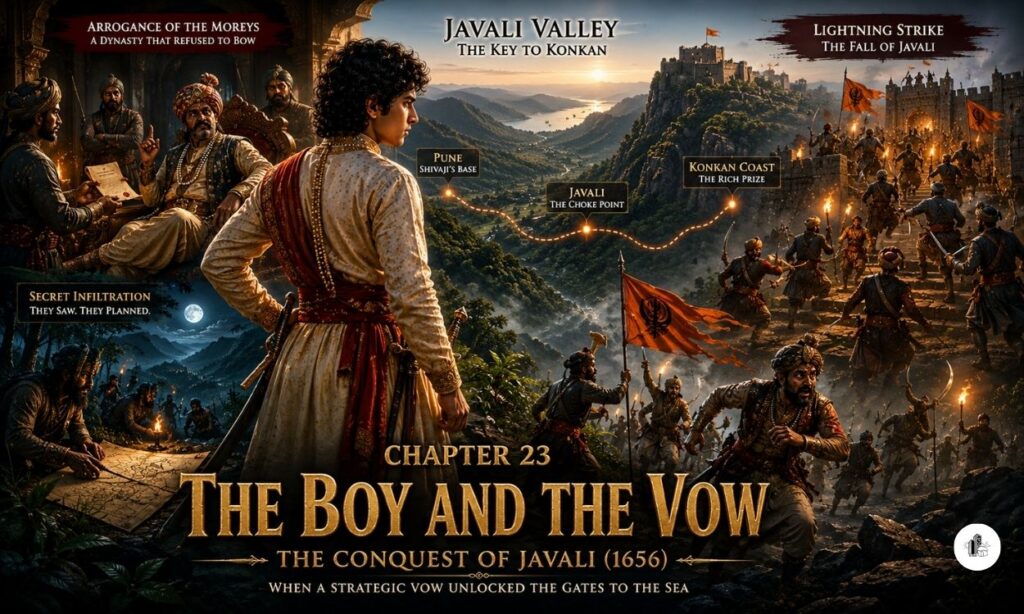
In January 1656, a highly trained infantry force moved in complete silence through the pitch-black jungle of the Mahabaleshwar hills. They carried no heavy flags or loud war drums. Their targets were not foreign soldiers from Persia or Africa. They were marching to eliminate Chandrarao Morey, a powerful local Maratha landlord who blocked the southern expansion of Swarajya.
The Morey clan of Javali had held their mountain kingdom for several generations. They ruled under a direct royal charter from the Adilshahi Sultanate of Bijapur.
  [Pune Valley] (Chhatrapati Shivaji Maharaj’s Base)
        │
        ▼ (The Geopolitical Blockade)
  [Javali Valley] (Ruled by the Morey Clan) ◄── Cold Mountain Choke Point
        │
        ▼ (The Missing Prize)
  [Konkan Coast] (Rich Maritime Trade Sea)
Chhatrapati Shivaji Maharaj could not march his troops down to the wealthy western sea ports without controlling Javali. This dense mountain valley was a vital geopolitical choke point. Leaving the Moreys in power meant the infant Maratha state would remain trapped in the Pune valleys forever. Chhatrapati Shivaji Maharaj decided to use a mix of cold psychological warnings, secret infiltration, and a lightning military strike to shatter the Morey blockade.
“Wait, have you read this yet?”
The Javali Problem: A Fortress of Trees
The geography of Javali was terrifying to normal military commanders. It was a dense, malaria-ridden jungle surrounded by massive basalt cliffs.
The local warriors of the Morey clan knew every single hidden animal track. Heavy imperial cavalry from Bijapur could never navigate these narrow, rocky passes. This natural defense made the Moreys incredibly arrogant. They believed they were completely untouchable.
Primary documents like the Jedhe Shakavali show that Chandrarao Morey refused to recognize Chhatrapati Shivaji Maharaj as a leader. He viewed Chhatrapati Shivaji Maharaj as a minor upstart uprooting the ancient feudal order.
The Rigid Feudal Identity: The Moreys valued their centuries-old imperial titles.
The Refusal to Cooperate: They actively sheltered criminals and spies who fled from Chhatrapati Shivaji Maharaj’s territory.
The Border Instability: They constantly disrupted the trade routes passing through the nearby Varandha ghat.
Chhatrapati Shivaji Maharaj sent a formal letter to Chandrarao, asking him to join the indigenous movement. He offered him a respected position in the new administrative core. Chandrarao sent back a mocking reply. He told the young prince to go home and play with toys. This insult sealed the fate of the Morey dynasty.
The Hidden Infiltration and Psychological Trap
Chhatrapati Shivaji Maharaj did not rush into an open-field battle. That would mean absolute suicide inside a dense mountain valley. He designed a clever multi-pronged intelligence operation instead.
He sent two of his most trusted operational officers, Raghunath Ballal Korde and Sambhaji Kavji, into Javali. Their official cover story was to negotiate a marriage alliance between the two powerful families.
The true mission was highly covert. For days, these men walked through the capital town. They mapped out the escape routes, noted down the hidden guard positions, and counted the internal garrison numbers.
| Operational Metrics | The Morey Defense System | The Maratha Strike Force |
| Primary Strength | Dense jungle terrain, generational local loyalty | High-speed mobility, extreme night stealth |
| Tactical Position | Securely barricaded inside a valley | Positioned at all mountain exit passes |
| Logistical Fuel | Standard valley grain storage | Simple, portable packs of millet Bhakri |
| Leadership Style | Arrogant, defensive feudal mentality | Cold, offensive administrative mindset |
While the negotiations were dragging on, Chhatrapati Shivaji Maharaj’s light infantry units silently moved into position. They crossed the high ridges of Mahabaleshwar without making a sound. They carried simple, dry rations of coarse Bhakri flatbread and spice paste, allowing them to camp out in the cold woods for days without building cooking fires.
The Lightning Assault on the Valley Capital
In early 1656, the operational trap snapped shut with brutal precision.
The Maratha emissaries inside the palace executed a high-risk surprise attack. They eliminated key members of the Morey leadership right inside their meeting chambers. Simultaneously, Chhatrapati Shivaji Maharaj’s hidden mountain units rushed down the steep slopes, attacking the town from multiple directions at once.
The Morey guards were completely caught by surprise. They expected an army to march down the main roads, not leap out from the deep forest paths. The defense broke down within a few hours of chaos.
Chandrarao’s sons fled up to the nearby mountain fortress of Rairi Fort. They hoped to hold out from the high stone walls. However, Chhatrapati Shivaji Maharaj pursued them relentlessly. He surrounded the mountain peak, cut off their fresh water supplies, and forced a total surrender.
Loving this analysis? Let’s stay connected!
Join our WhatsApp & Telegram Channels: Get the latest movie alerts and box office updates directly on your phone. [WhatsApp] & [Telegram]
Follow us on X (Twitter): For quick threads, daily polls, and viral cinema news. [Click Here]
Join our Quora Space: Participate in deep discussions and share your own theories with fellow movie buffs. [Click Here]
The Structural Shift: Unlocking the Western Sea
The capture of Javali was the most important local conquest since the taking of Torna Fort. It permanently altered the regional demographic and financial balance.
[Old Feudal Fragmentation]                  [New Sovereign Integration]
Isolated clans fight over local land   ►►   Unified military system guards the state
Tax revenues wasted on luxury courts   ►►   Gold re-invested into building new border walls
Western sea trade blocked by lords     ►►   Direct trade routes opened to the Konkan coast
Chhatrapati Shivaji Maharaj did not just destroy a stubborn rival family. He absorbed their entire army into his own ranks. Thousands of veteran mountain infantrymen from the Javali region swore allegiance to the Swarajya blueprint.
Chhatrapati Shivaji Maharaj also discovered old property arbitration papers, known as Mahazars, in the Morey offices. He honored the land titles of the innocent common farmers. This fair treatment proved to the local population that he was a just administrator, not a cruel conqueror.
The greatest prize was purely geographic. The dense valleys of Javali provided a direct, unobstructed passage down to the rich Konkan coast. The young prince was no longer landlocked in the hills of Pune. He now possessed a straight path to international maritime trade.
Securing the New Frontier
The fall of the Morey clan sent a clear, terrifying message to every feudal lord in the Deccan. Chhatrapati Shivaji Maharaj would not tolerate internal division or foreign puppets inside his home territory.
He looked at the towering mountain peak of Rairi, which he had just captured from the Moreys. He recognized its immense structural value. A few years later, he would transform that very same peak into Raigad Fort – the grand capital of his future independent empire. The northern plains were already safe, the southern mountain gates were locked, and the western passage was finally open.
What Do You Think?
Do you think Chhatrapati Shivaji Maharaj’s secret infiltration strategy against the Morey clan of Javali was completely justified to create a unified nation, or was it too ruthless a move against a fellow Maratha family? How important is absolute geographic control when a small state is fighting for survival?