
The Swarajya Chronicles: Book 2, Chapter 16
Current Focus: The Boy and the Vow (1630–1647)
Progress: 16 / 100 Chapters Completed….
In 1645, the Bijapur Sultanate held a flawless paperwork monopoly over the Western Deccan. Imperial registries cataloged every land parcel, tax yield, and fort garrison. Yet, these massive paper archives missed the real human landscape. Revolutionary movements do not start with massive, state-funded standing armies. They require a small, highly disciplined core of local operators.
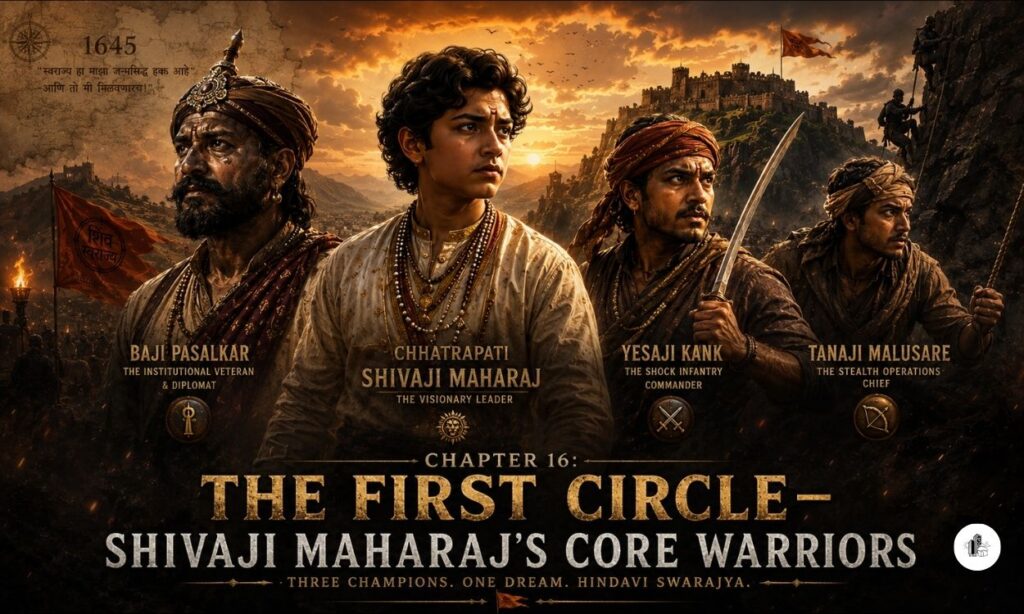
Chhatrapati Shivaji Maharaj built his inner circle from three specific military demographics in the Maval hills. This was a calculated grouping of seasoned veterans, raw physical shock-troops, and master stealth tacticians.
Primary records like the contemporary Jedhe Shakavali and old judicial Mahazars reveal their distinct identities. This chapter dissects the operational profiles of Baji Pasalkar, Yesaji Kank, and Tanaji Malusare. They formed the first circle of steel that launched Swarajya.
Baji Pasalkar: The Institutional Veteran and Diplomat
The young prince could not recruit thousands of valley youth without local institutional backing. He needed a senior military anchor to legitimize his new command structure. Baji Pasalkar filled this exact structural gap.
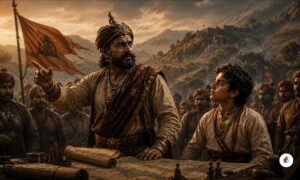
Unlike the younger valley recruits, Baji Pasalkar was an established, veteran Deshmukh from the Mose Maval region. Baji Pasalkar held a legal, hereditary land fiefdom granted by the Adilshahi court. He was already a seasoned military commander with decades of active service, possessed a deep, practical understanding of Deccani diplomatic frameworks. His recruitment brought instant political legitimacy to the young prince’s underground operations.
Baji Pasalkar controlled vital regional pathways and held deep family networks across multiple valleys. He did not merely join a rebellion. Baji Pasalkar active-tested the prince’s strategic resolve. He opened his private armories and supply networks to the movement.
Tragically, he died during the brutal Battle of Khalad-Khind while fighting imperial loyalist forces. His ultimate sacrifice protected the infant state during its first major defensive retreat. He proved to the local population that even wealthy, established landlords were now willing to die for complete independence.
“Wait, have you read this yet?”
Yesaji Kank: The Shock Infantry Commander
If Pasalkar was the strategic brain, Yesaji Kank was the raw, physical muscle of the early Maratha army. Born in the rugged Bhore region, Kank belonged to the tough Silibam clan of light mountain infantrymen.
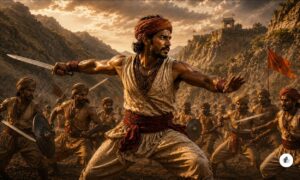
Regional military folklore frequently celebrates his incredible, near-superhuman physical traits. Traditional accounts claim he later defeated a rampaging war elephant in open combat at the Golconda court. Stripped of myth, his actual military record reveals a master of close-quarters combat. Yesaji Kank took charge of the specialized vanguard units of the early Maratha light infantry.
He standardized the brutal Mardani Khel martial drills across the entire Maval recruitment pool, trained raw valley farmers to use the straight Dhop sword with lethal efficiency.
Yesaji Kank specialized in holding narrow mountain passes against advancing cavalry columns. His heavy infantry tactics relied entirely on extreme physical endurance and high-speed directional changes. He turned the common peasantry into a professional cadre of lethal, terrain-compliant shock-troops.
Tanaji Malusare: The Architect of Stealth Operations
An asymmetric insurgency cannot survive by fighting fair, open battles. It requires an advanced intelligence apparatus and elite stealth capabilities. Tanaji Malusare designed this exact shadow framework for the early Maratha state.

Hailing from the village of Umrathe, Malusare shared a deep, lifelong personal bond with Chhatrapati Shivaji Maharaj. Tanaji Malusare combined a native, intimate knowledge of the rugged Konkan valleys with a brilliant tactical mind. He became the chief architect of the Maratha covert reconnaissance wings, mapped out foreign fort systems, bribed garrison guards, and calculated exact attack timelines.
Contemporary ballads like the Sinhagada Powada record his terrifying focus on operational discipline.
His tactical style completely rejected slow, heavy, conventional military movements. He preferred fast, high-risk fortress infiltrations under the cover of pitch-black night or blinding monsoon downpours. He treated vertical basalt cliffs as open, usable highways. His lethal, light-footed assault squads struck deep inside enemy strongholds before the alarms could even sound. This specific operational methodology reached its absolute peak during the legendary, high-altitude night assault on Fort Kondhana.
The Structural Synergy of the First Circle
The true genius of Chhatrapati Shivaji Maharaj lay in how he combined these three completely different human assets into a single military machine. He did not let internal rivalries destroy his core leadership team.
Chhatrapati Shivaji Maharaj used Baji Pasalkar to open the political doors of the valley landlords. He deployed Yesaji Kank to physically train the incoming wave of peasant recruits, utilized Tanaji Malusare to execute the brilliant, high-stakes operations that captured imperial forts without costly, multi-month sieges.
This was a highly modern approach to building a command hierarchy. They did not fight for money, imperial titles, or foreign validation, ate the same simple Bhakri flatbread on the march, bled together in the same muddy trenches. This deep, unshakeable trust transformed a small group of local operators into a highly effective revolutionary high command.
| Operational Attribute | Baji Pasalkar | Yesaji Kank | Tanaji Malusare |
| Primary Role | Institutional Anchor | Shock Infantry Lead | Stealth Operations Chief |
| Tactical Specialization | Line Warfare & Diplomacy | Close-Quarters Combat | Asymmetric Reconnaissance |
| Geographic Base | Mose Maval | Bhore Region | Umrathe (Konkan/Maval) |
| Core Contribution | Legitimized Rebellion | Standardized Martial Drill | Mastered Fortress Infiltration |
Loving this analysis? Let’s stay connected!
Join our WhatsApp & Telegram Channels: Get the latest movie alerts and box office updates directly on your phone. [WhatsApp] & [Telegram]
Follow us on X (Twitter): For quick threads, daily polls, and viral cinema news. [Click Here]
Join our Quora Space: Participate in deep discussions and share your own theories with fellow movie buffs. [Click Here]
The Bedrock of Swarajya
By combining veteran diplomacy, elite physical strength, and master stealth tactics, the young prince secured his foundation. The imperial courts of Bijapur completely failed to counter this brilliant human synergy. They sent heavy cavalry, but the first circle simply weaponized the mountain terrain.
These three men transformed the loose ideals of freedom into a functional, highly lethal reality. They proved that an empire is not built by large treasuries alone. It is built by the unshakeable loyalty of a disciplined core team. The first circle was now complete, armed, and ready to strike the first major blow against imperial rule.
What Do You Think?
Which of these three distinct operational roles do you think was most critical for the early survival of the Maratha state? Would you prefer a veteran diplomat like Pasalkar, a powerful shock commander like Kank, or a stealth expert like Malusare to lead a modern startup team?