

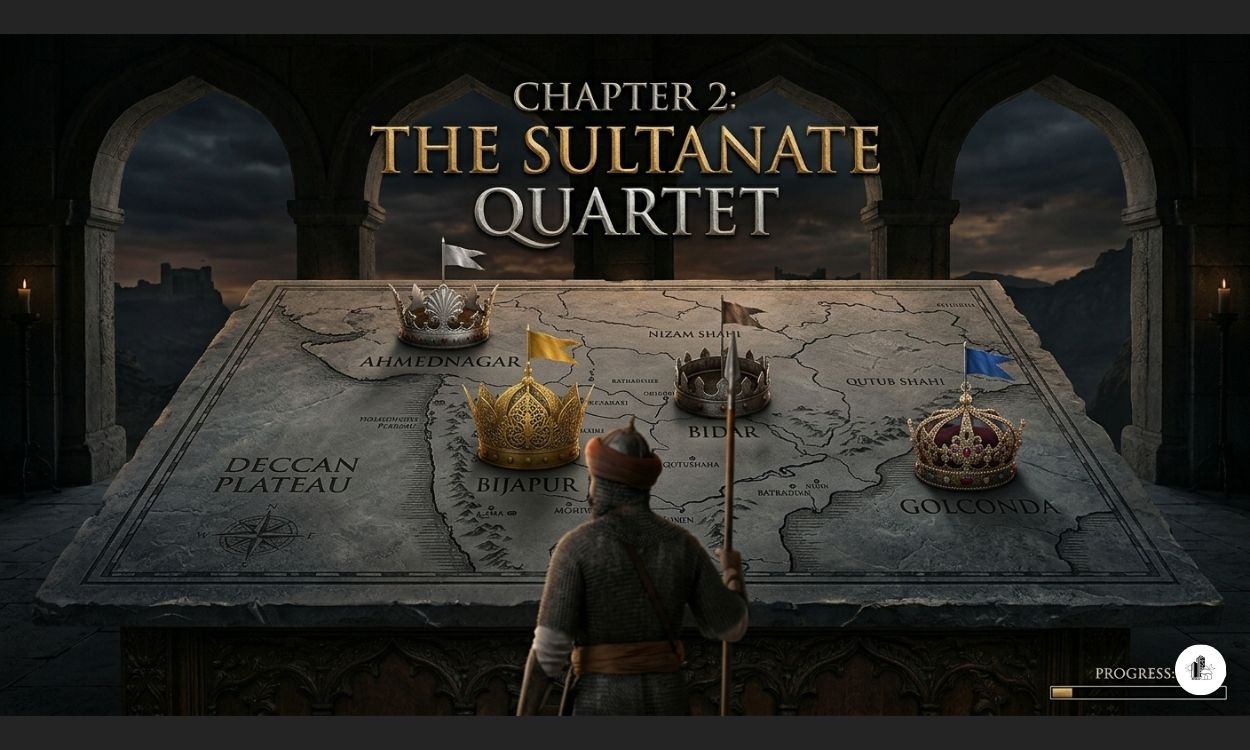
The Swarajya Chronicles: Book 1, Chapter 2
Current Focus: The Pre-Swarajya Landscape (1300–1630)
Progress: 02 / 100 Chapters Completed
Have you ever wondered how a society survives when it is pulled in four different directions for three centuries? This is the story of The Sultanate Quartet: Decoding the Adil Shahi, Nizam Shahi, Qutub Shahi, and Barid Shahi. How our land was divided and how our people were used as tools in a game of thrones.
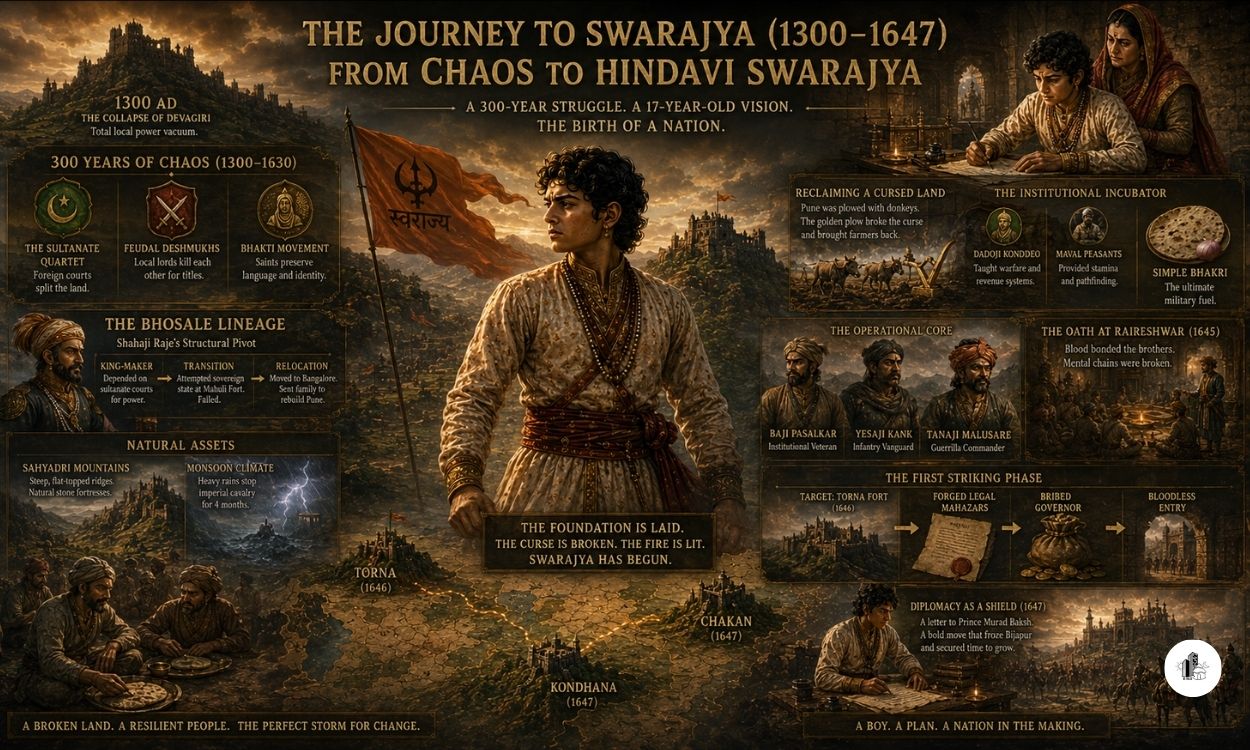
After the fall of Devagiri, the Deccan didn’t just become “poor.” It became a laboratory for foreign rule. The Bahmani Empire, which once ruled the south, shattered into pieces. By the late 1400s, four major Sultanates emerged. They were not just kingdoms; they were four different versions of the same struggle. To understand the world Shivaji Maharaj was born into, we must look at the “Minor Details” of these four crowns.
The Anatomy of the Breakup
The Bahmani Sultanate was a giant. But as the saying goes, the bigger they are, the harder they fall. Internal fights between the “Deccanis” (local Muslims) and the “Afagis” (foreign-born Muslims) weakened the core. By 1490, the governors stopped sending taxes to the capital, Bidar.
Imagine a house where every family member locks their door and claims the room belongs to them. That was the Deccan. Each room became a Sultanate. Each Sultan had his own army, his own spies, and his own hunger for more land.
1. The Nizam Shahi of Ahmednagar (The Heart of the Struggle)
The Nizam Shahi was established by Malik Ahmad Nizam Shah. This kingdom sat right on top of the Maratha heartland. Their territory included the Sahyadri forts like Shivneri and Junnar.
The Rise of the Maratha Nobility Because the Nizam Shahi was constantly fighting the Mughals from the North, they could not rely on foreign soldiers alone. They needed people who knew the mountains. This is where families like the Jadhavs of Sindkhed and the Bhonsles of Verul became powerful. They weren’t just soldiers; they became Sardars.
However, there was a catch. The Nizam Shahi court was famous for its “Bloody Politics.” A Sardar could be rewarded with a village today and beheaded tomorrow. This taught the Maratha leaders a hard lesson: Mastery is temporary; land is everything.
“Wait, have you read this yet?“
The Swarajya Chronicles: Why We Are Rebuilding the Story of a King
2. The Adil Shahi of Bijapur (The Powerhouse of the South)
If the Nizam Shahi was the heart, the Adil Shahi was the muscle. Founded by Yusuf Adil Shah, this kingdom was incredibly wealthy. They controlled the ports of the Konkan, which meant they controlled the flow of horses from Arabia and silk from Europe.
The Shiledar vs. Bargir System The Adil Shahis perfected a military structure that would later be used against them. They divided their cavalry into two:
The Bargirs: These were state-sponsored soldiers. The Sultan gave them the horse and the armor. They were loyal only to the paymaster.
The Shiledars: These were independent Maratha warriors. They brought their own horses and their own weapons. They were basically private military contractors.
This allowed Maratha families to maintain their own mini-armies. It was this “Shiledari” pride that Chhatrapati Shivaji Maharaj later transformed into a national army.
3. The Qutub Shahi of Golconda (The Bankers of the Deccan)
While the others fought, the Qutub Shahis focused on the “Diamond Economy.” Based in modern-day Hyderabad, they controlled the world-famous Golconda mines.
The Brahmin Ministers In a surprising move, the Qutub Shahi kings often employed local Telugu and Marathi Brahmins to run their administration. Names like Madanna and Akkanna became famous. They ran the tax systems and the diplomacy. This showed that while the Sultans held the sword, the local brains were still running the machinery. This expertise in “State-craft” would later help the Maratha administration when they built their own council, the Ashta Pradhan Mandal.
4. The Barid Shahi of Bidar (The Small but Deadly Pivot)
The Barid Shahis were the “Puppet Masters.” They were the smallest kingdom, but they held the old Bahmani capital. They survived for over 100 years simply by making the other three fight each other.
The “Turks of the Deccan” The Barid Shahis were experts in fortress engineering and artillery. They maintained some of the most complex forts in the central Deccan. Their survival proved that knowledge of geography and fort-defense is more important than the size of your army. This was a lesson that the young Shivaji would study very closely.
The “Watan” System: The Invisible Chains
We cannot talk about the truth of our history without talking about the “Watan.” The Sultans knew they couldn’t rule every village. So, they gave local leaders (Deshmukhs and Deshpandes) a “Watan” – a permanent right to collect tax and rule a small area.
This was a brilliant and evil strategy. It turned Maratha against Maratha. If two families fought over a boundary, they would both go to the Sultan to settle it. The Sultan became the judge, and the Marathas became the servants. People began to love their “Watan” more than their “Religion” or their “Soil.” Breaking this “Watan mindset” was the biggest challenge for the future Swarajya.
The Abyssinian Genius: Malik Ambar
There is one man we must mention to be historically accurate: Malik Ambar. He was an African slave who rose to become the Prime Minister of the Nizam Shahi.
The Inventor of Guerrilla Warfare Malik Ambar realized that he couldn’t beat the massive Mughal armies in an open field. So, he trained Maratha soldiers in “Bhal-Giri” (Spear-fighting) and “Ganimi Kava” (Guerrilla tactics).
Malik taught them to hit fast and vanish into the Sahyadris and proved that a small, fast force could defeat a giant empire. He used the mountains as a weapon, used the monsoon as a shield.
Shahaji Raje (the father of Chhatrapati Shivaji Maharaj) was one of Malik Ambar’s top commanders. He saw this strategy work first-hand. This is the absolute truth of how the military foundation of Swarajya was laid. It wasn’t magic; it was a 30-year apprenticeship under the greatest tactical mind of that era.
The Social Reality: Life in the Shadows
What was the life of a layman like? It was a life of “Double Taxation.” You paid the Sultan, and you paid the local Deshmukh. If a war happened, the armies would trample your crops. There was no law to protect a woman’s honor or a temple’s sanctity.
The people were physically strong but mentally orphaned. They had the weapons, they had the forts, and they had the bravery. But they lacked Direction. They were fighting for the four crowns, never for themselves.
Loving this analysis? Let’s stay connected!
Join our WhatsApp & Telegram Channels: Get the latest movie alerts and box office updates directly on your phone. [WhatsApp] & [Telegram]
Follow us on X (Twitter): For quick threads, daily polls, and viral cinema news. [Click Here]
Join our Quora Space: Participate in deep discussions and share your own theories with fellow movie buffs. [Click Here]
What Do You Think?
We have looked at the four crowns that ruled our land. They were powerful, wealthy, and organized. But they had one fatal flaw: they didn’t belong to the people.
If you were a Maratha Sardar in 1550, would you have stayed loyal to a Sultan, or would you have dreamed of something more?
Why do you think it took 300 years for someone to challenge this “Watan” system?
In the next chapter, we look at the Mughal Shadow. The giants from Delhi are finally moving South. The stage is getting crowded, and the pressure is building.
The Mahagranth continues. Share your thoughts below!







Leave a Reply