
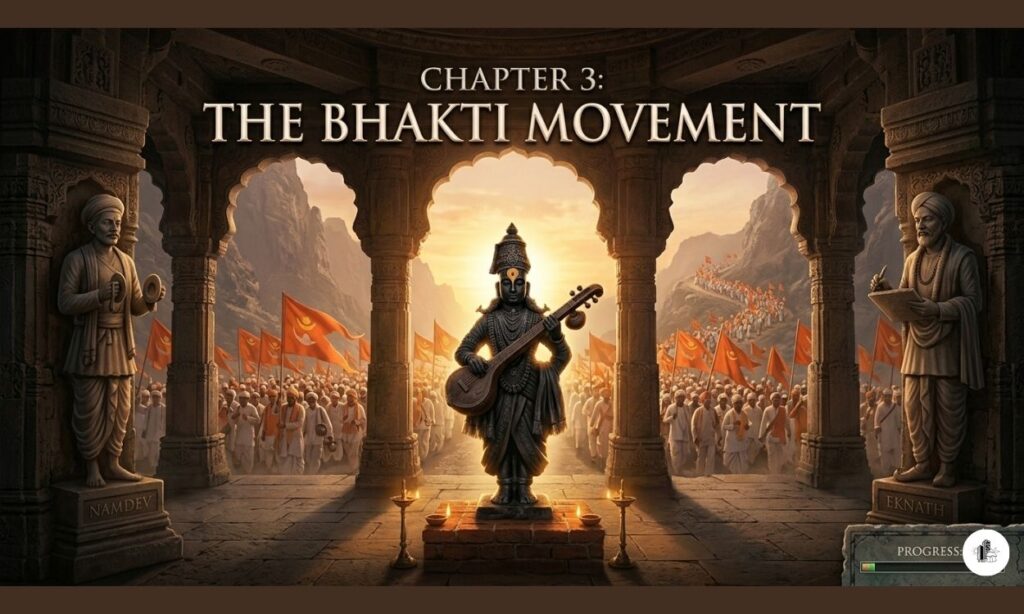
The Swarajya Chronicles: Book 1, Chapter 3
Current Focus: The Pre-Swarajya Landscape (1300–1630)
Progress: 03 / 100 Chapters Completed
The kings banned your language from the royal courts. They broke your temples and erased your identity. During 300 years of Sultanate rule, foreign monarchs held the land and conducted administration in Persian. Common people lived like strangers in their own villages.
However, even as the Sultans captured the stone forts, they could not imprison the “Mind” of the people. The Bhakti Movement launched a silent revolution. The people did not fight with swords or shields. Instead, they fought with songs, poems, and the Marathi language. In this way, the saints built an invisible fort that no Sultan could ever conquer.
The Language of the Soil: Why Marathi Mattered
Before the Bhakti saints, most religious knowledge was locked in Sanskrit. Only a few learned people could understand it. The common farmer or worker had no access to these deep truths. When the Sultanates arrived, Persian became the language of power and money. Marathi was pushed to the corners.
The Bhakti movement changed this completely. Saints like Sant Dnyaneshwar and Sant Namdev made a bold choice. They decided to speak and write in the language of the people. They proved that God does not only understand Sanskrit. This move gave the Marathi language a new life. It made the people proud of their mother tongue again. This was the first “Minor Detail” that prevented the total cultural collapse of the Deccan.
Sant Namdev: The Architect of Unity
Sant Namdev lived during a very difficult time. He saw the transition from the Yadavs to the Khiljis. He realized that a society without a common identity is a weak society.
The Punjab Connection Namdev did not stay only in Maharashtra. He traveled all the way to Punjab. His songs are actually included in the Guru Granth Sahib. He was the first saint to build a bridge across India.
Equality in Devotion: He taught that caste did not matter in front of Panduranga. He had followers from every background. This created a sense of “Humanity” that the Sultanate system was trying to destroy.
The Kirtan: He popularized the Kirtan (musical storytelling). This became the “Social Media” of the 1300s. Through Kirtans, news and values traveled from one village to another.
“Wait, have you read this yet?“
Chapter 4: The Deshmukhs – The Guardians and the Gangsters of the Deccan
The Sultanate Quartet: Decoding the Adil Shahi, Nizam Shahi, Qutub Shahi, and Barid Shahi
The Gap of Silence and the Rise of Sant Eknath
After Namdev, there was a long period of heavy war and suffering. For almost 200 years, the voices of the saints were quiet. The Sultanates were at their peak. Then, in the 1500s, Sant Eknath appeared in Paithan. If Namdev was the architect, Eknath was the protector.
Eknath Maharaj faced a very different world. The Islamic influence was now very deep in the administration. He saw that the people were becoming “Slaves by Mind.” They had forgotten their own history. He took it upon himself to wake them up.
The Bharuds: Drama with a Message
Sant Eknath was a genius at communication. He knew that simple sermons might be boring for a layman. So, he invented the Bharud. These were short, funny, and dramatic poems.
-
Sant Eknath would dress up as a wandering beggar or a farmer to perform these.
-
He used the daily struggles of a common man to explain high philosophy.
-
Each Bharud ended with a message of self-respect and truth.
This was the “Forensic Truth” of his strategy. He made the common man think. He used humor to fight fear. This prevented the local culture from being swallowed by the Persian influence of the courts.
The “Verification Layer”: Rebuilding the Dnyaneshwari
Here is a micro-detail that shows the dedication of Sant Eknath. By his time, the original text of Dnyaneshwari (written in 1290) was corrupted. People had changed the words over time. Eknath Maharaj spent years researching the original verses. He cleaned the text and gave the people the “Pure” version of Dnyaneshwar’s wisdom. Why does this matter? Because he ensured that the Intellectual Compass of Maharashtra was accurate. He gave the people a common book to follow.
Social Equality: The Story of the “Untouchable”
Eknath Maharaj practiced what he preached. There are records of him eating at the house of a person from a lower caste. This was a massive scandal in the 1500s. But he didn’t care. He argued that if God is everywhere, then every human is sacred.
This social equality was the “hidden fuel” for Swarajya. When Shivaji Maharaj later built his army, he didn’t care about caste. He cared about character. This mindset was prepared 100 years earlier by Eknath Maharaj. He broke the internal walls of the society so that a unified army could one day be built.
The Preservation of History: The “Bhakti” Archive
We often think of saints as only religious people. But they were the best historians of their time.
The songs (Abhangas) of these saints contain details about the famines, the taxes, and the behavior of the Sultans.
They kept the memory of the Yadav kings alive. They reminded the people that they were once independent.
Without this “Oral Archive,” the Maratha people would have forgotten who they were. They would have accepted their life as servants forever. The Bhakti movement kept the “Marathi” heart beating even when the body was in chains.
Preparing the Ground for Shahaji Raje and Shivaji
By the early 1600s, the work of the saints was complete.
-
The people had a common language (Marathi).
-
They had a common center of worship (Pandharpur).
-
A sense of social equality.
-
Had regained their self-respect.
The “Mental Swarajya” was already there. The land was ready. The people were just waiting for a leader who could give this spiritual energy a physical sword. Shahaji Raje Bhonsle grew up in this environment. He saw the power of the Warkari (the pilgrims). He saw how thousands of people walked together in unity. This unity was the blueprint for the Maratha Empire.
Loving this analysis? Let’s stay connected!
Join our WhatsApp & Telegram Channels: Get the latest movie alerts and box office updates directly on your phone. [WhatsApp] & [Telegram]
Follow us on X (Twitter): For quick threads, daily polls, and viral cinema news. [Click Here]
Join our Quora Space: Participate in deep discussions and share your own theories with fellow movie buffs. [Click Here]
What Do You Think?
We often focus only on wars and kings. But can an empire survive without a strong culture?
-
Do you think Shivaji Maharaj could have succeeded if the saints hadn’t united the people first?
-
How important is language in keeping a nation’s soul alive today?
In the next chapter, we look at the Mughal Shadow. The giant from Delhi is finally moving South. The stage is getting crowded. The Sultanates are scared, and the Bhakti energy is about to meet the world of politics.
The Mahagranth continues. Share your thoughts in the comments below!