
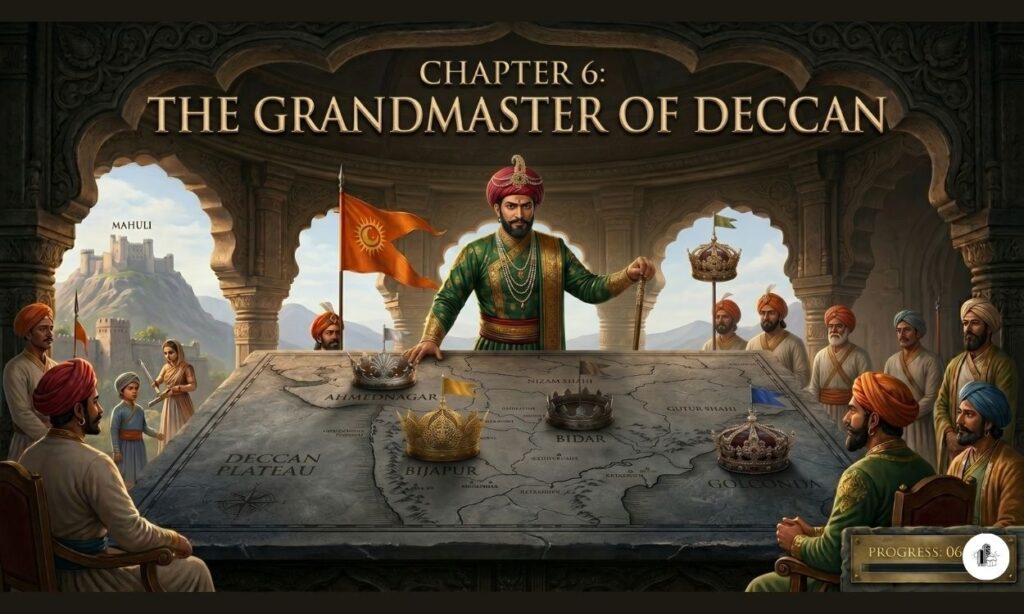
The Swarajya Chronicles: Book 1, Chapter 6
Current Focus: The Pre-Swarajya Landscape (1300–1630)
Progress: 06 / 100 Chapters Completed….
The history of the Maratha Empire is often reduced to epic battles and clashes of steel. But a closer look shows a different foundation. Chhatrapati Shivaji Maharaj’s dream of Swarajya was not built by war alone. It was shaped by strategy, diplomacy, and calculated decisions.
If Maloji Raje brought the Bhosale name into royal circles, his son Shahaji Raje Bhosale took it further. He turned the family from respected warriors into a geopolitical force capable of influencing powerful Sultans.
By the early 17th century, the Deccan plateau had become a chaotic, high-stakes chessboard. The Mughal eagle, led by the ambitious Emperor Shah Jahan, was casting a long, predatory shadow southward. The established Sultanates were crumbling under the weight of internal strife and external pressure. In this perfect storm of political instability, Shahaji Raje emerged not merely as a talented general, but as the ultimate “Kingmaker.”
The Sultanate Quartet: A Game of High-Stakes Survival
To truly appreciate the genius of Shahaji Raje, one must first grasp the complexity of the Sultanate Quartet. Three primary Islamic powers divided and fought over the volatile Deccan: the Nizam Shahi of Ahmednagar, the Adil Shahi of Bijapur, and the Qutb Shahi of Golconda. Above them all loomed a fourth and far more formidable force – the Mughal Empire.
Shahaji Raje’s primary genius lay in his uncanny ability to navigate these shifting sands. He was one of the few leaders of his era who realized a fundamental truth: for a distinct Maratha identity and land to survive, no single power in the Deccan could be allowed to become absolute. If the Mughals won, local autonomy would vanish. If one Sultanate crushed the others, Maratha influence would be sidelined.
The Puppet Master of Mahuli
When the Nizam Shahi Sultanate was on the very brink of extinction following the fall of Daulatabad, Shahaji did the unthinkable. While others were switching sides to join the winning Mughals, Shahaji retreated to the mountain fortress of Mahuli. He found a young scion of the Nizam Shahi royal family, declared him the rightful Sultan, and began ruling the remains of the kingdom in the boy’s name.
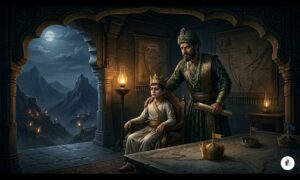
This wasn’t an act of blind loyalty to a dying dynasty. It was a calculated move to maintain a “buffer state.” By keeping the Nizam Shahi alive, he kept a barrier between the Mughal expansionists and the rest of the Deccan. For three grueling years, Shahaji single-handedly challenged the combined might of the Mughal Empire and the Bijapur forces. He wasn’t just fighting for a boy king; he was testing the structural integrity of Maratha resistance. He was proving to the world—and to his own people—that a Maratha leader could hold his own against an Emperor.
“Wait, have you read this yet?“
Chapter 7: Shahaji Raje (Part II) – The Mahuli struggle and move to Bangalore.
Chapter 5: The Bhosale Lineage – From Verul to the Service of the Sultans
The Statesman’s Wardrobe: A Visual Shift in Sovereignty
As we tracked the progression from Babaji to Maloji, we saw a steady rise in status. However, Shahaji’s appearance in historical records, contemporary paintings, and oral traditions marks a seismic departure from his predecessors.
“His attire was no longer just functional armor for the muddy trenches of war; it was a curated statement of sovereignty.”
In the grand Darbars (royal courts) of Bijapur and Ahmednagar, Shahaji was no longer the dusty cavalryman. He was seen in fine brocaded silks (Himroo and Paithani styles), structured turbans (Pheta) adorned with jeweled sarpechs, and layers of pearl-encrusted jewelry.
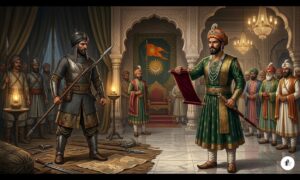
This shift toward the “better,” more refined aesthetic was a deliberate political tool. In the 17th century, visual authority was synonymous with political legitimacy. To negotiate with Sultans and Mughal envoys as a peer rather than a servant, Shahaji had to embody the prestige of a King. This refined appearance signaled to the surrounding empires that the Bhosales had evolved. They were no longer mere “Mercenaries for Hire”; they were Masters of their own Destiny. Every pearl and every silk thread was a message to the Sultans: “I am the power that keeps your throne stable.”
Building the “Swarajya Blueprint”
While Shahaji was engaged in high-level diplomacy and military campaigns in the deep south—expanding his influence near Bangalore, Kanakagiri, and Tanjavur—he was simultaneously executing a “Silent Revolution” in the north. He was creating what historians now recognize as the Administrative Sanctuary.
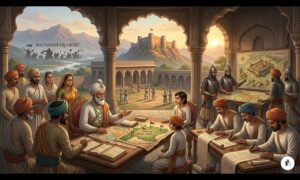
1. The Pune Jagir: The Laboratory of Liberty
Shahaji Raje made a pivotal decision to entrust his Pune Jagir (fiefdom) to his wife, Jijabai, and his young son, Shivaji. While he dealt with the storms of the South, he ensured that this small pocket of the Sahyadris became a protected zone.
2. The Council of Mentors
Shahaji didn’t just leave his family with land; he left them with a “Shadow Government.” He sent his most trusted and seasoned administrators, most notably Dadoji Konddeo, along with a core group of loyal military commanders. These men weren’t just tutors; they were the architects of a new system of governance that prioritized justice, land reform, and local pride—values that would become the pillars of the Maratha State.
3. The “Political Shield”
This is perhaps the most misunderstood part of Shahaji’s life. Shahaji served the Adil Shah of Bijapur with distinction in the Carnatic campaigns, making himself too valuable to execute or ignore. He acted as a political shield. As the Sultanate’s most powerful southern general, he discouraged harsh action against his son’s “rebellion” in Pune.
He secured a quiet space in the Sahyadri valleys, where the seeds of Hindavi Swarajya could grow safely.
The Legacy of the Diplomat: Realpolitik in Action
Shahaji Raje’s life was a masterclass in Realpolitik—the politics of reality over idealism. He proved that a warrior’s greatest weapon isn’t always the Bhavani Talwar; often, it is the ability to remain indispensable to your enemies.
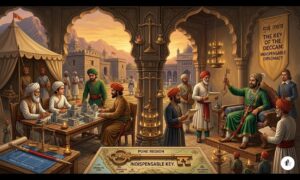
He made himself the “Key of the Deccan.” No throne was stable without his support, and no campaign was successful without his cavalry. He navigated a world of betrayal and shifting allegiances not by being “loyal” in the traditional sense, but by being loyal to the survival of his lineage and his land.
Shahaji Raje didn’t just father a king; he built the state’s foundation. He created diplomacy, military strength, and political legitimacy. This allowed a young Shivaji Maharaj to rise from “rebel” to Chhatrapati. Shahaji played the Sultans’ game so his son could overturn it entirely.
Loving this analysis? Let’s stay connected!
Join our WhatsApp & Telegram Channels: Get the latest movie alerts and box office updates directly on your phone. [WhatsApp] & [Telegram]
Follow us on X (Twitter): For quick threads, daily polls, and viral cinema news. [Click Here]
Join our Quora Space: Participate in deep discussions and share your own theories with fellow movie buffs. [Click Here]
What Do You Think?
Shahaji Raje is often a polarizing figure in historical discussions. Some see his service to the Sultanates as a necessary compromise—a “mask” he wore to protect the growing movement in Pune. Others argue that he was simply a brilliant career general who eventually realized his son was doing what he never could.
The Kingmaker’s Dilemma: Do you believe Shahaji Raje was secretly orchestrating the rise of Swarajya from the shadows of the Bijapur court? Or was he a man caught between his duty to the Sultans and his love for a son who was breaking all the rules?